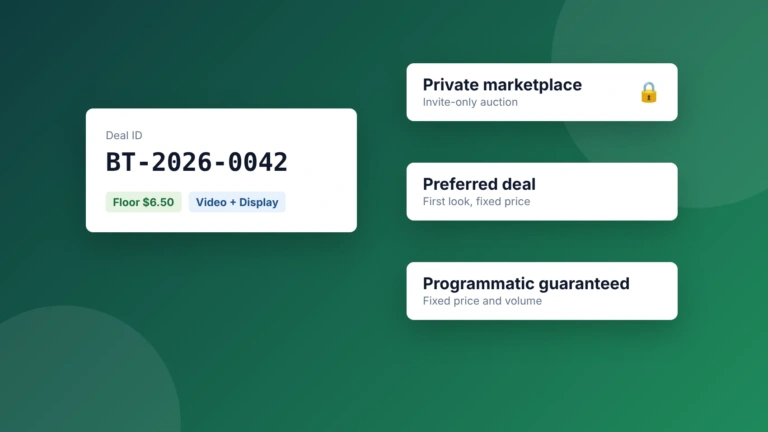
Most programmatic buying used to happen in the open marketplace, where anyone can bid on almost anything. Today a large share of spend runs through deals. Among the big advertisers in the ANA's Q2 2025 benchmark, private marketplace deals made up 87.8% of spend, and the ANA's Q3 2025 report put the figure at 81.6%. This guide explains the deal types, what a deal ID does and when each type makes sense.
What is a deal ID?
A deal ID is a short code that the publisher (or its SSP) creates and shares with a buyer. It is sent in the bid request together with the impression. The buyer sets up the same ID in its DSP, so the DSP knows "this impression is part of our agreed deal" and bids with the agreed rules: price, targeting, formats and priority.
The deal ID itself doesn't carry money or targeting. It is a key that both sides use to match the same agreement.
The four ways to buy programmatically
| Type | Who can bid | Price | Volume guaranteed? | Good for |
|---|---|---|---|---|
| Open auction | Any buyer | Auction, often with a floor | No | Reach and scale at low cost |
| Private marketplace (PMP) | Invited buyers only | Auction with a higher floor | No | Quality sites and audiences with some competition |
| Preferred deal | One buyer, first look | Fixed price | No | Priority access to a publisher without a commitment |
| Programmatic guaranteed | One buyer | Fixed price | Yes | Planned campaigns, launches, sponsorships |
Private marketplaces (PMPs)
A PMP is an auction that only invited buyers can join. The publisher picks the inventory (for example, all sports pages, or one video player) and sets a floor price, usually higher than in the open auction. Buyers compete, and the highest bid wins. PMPs cost more per thousand impressions, but you know where your ads run. In the ANA Q2 2025 data, PMP CPMs averaged $7.15 against $4.41 in the open market.
Preferred deals
In a preferred deal, one buyer gets to see the impression before the auction at a fixed price. If the buyer passes, the impression goes on to the PMP or open auction. It is useful when you want steady access to a specific publisher but can't promise a volume.
Programmatic guaranteed
Programmatic guaranteed (PG) is a classic direct buy, with a fixed price and a fixed number of impressions, delivered through your DSP. The publisher reserves the inventory, and you commit to buying it. PG suits campaigns where delivery matters more than price, like product launches or sponsorships of a section.
Curated deals
Curated deals bundle many publishers into one deal ID, often with audience data on top. They are packaged by an SSP, an agency or a data company. They are easy to buy and can scale, but ask what is inside: which sites, which seller IDs, what extra fee. A curated deal without clear supply can hide the same problems as the open market. See our guide to supply path optimization.
How to set up a deal, step by step
- Agree on the terms with the publisher or its sales house: inventory, formats, dates, price or floor, and volume if any.
- The publisher creates the deal in its SSP and sends you the deal ID and the SSP name.
- You add the deal ID to a line item in your DSP and target it.
- Run a short test and check the first numbers: bid requests, bids, win rate and spend.
- If nothing delivers, check the usual issues: your bid is under the floor, targeting is too narrow, wrong formats or sizes, or the deal is not active on one side.
What deals mean for publishers
Deals are where much of the premium money now goes. Publishers who want it need clean ads.txt and sellers.json entries, good viewability and clear audience or contextual segments to package. Even smaller publishers can join curated deals through their SSPs.
FAQ
Is a PMP always better than the open auction?
Not always. PMPs give you more control and usually better quality, but at a higher CPM. For reach campaigns with strong brand safety and SPO rules, the open auction can still work well. Use the CPM calculator to compare real costs.
Why is my deal not spending?
The most common reasons are a bid below the floor, targeting that excludes most of the deal's traffic, creative sizes the publisher doesn't have, or the deal being paused on the SSP side. Ask the publisher for the deal's bid request volume to see where it breaks.
Can one deal ID work across several SSPs?
Usually no. A deal ID is created in one SSP. If a publisher offers the same deal through two SSPs, you get two IDs.