
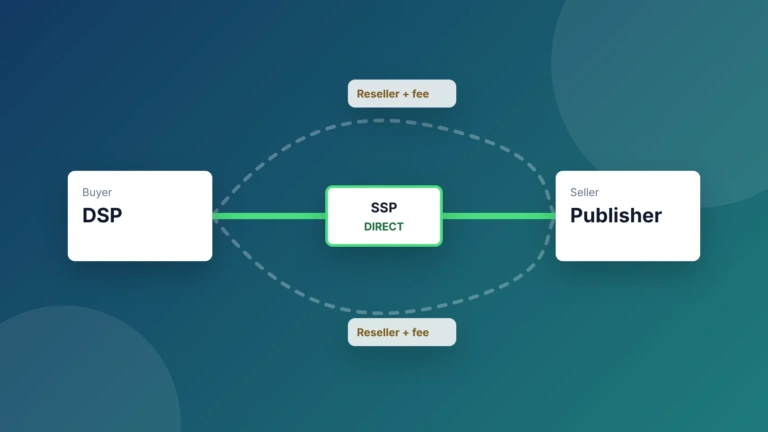
When you buy an ad on the open web, the same impression can reach your DSP through five, ten or more different routes. Each route takes a cut. Some are direct from the publisher, some go through one or two resellers, and some pass through companies you have never heard of. Supply path optimization is the work of finding the routes that give you the most real, viewable impressions for each dollar, and dropping the rest.
Why the same impression arrives many times
Most publishers run header bidding, so one page view is offered to many SSPs at once. Many publishers also work with resellers and monetization partners, who bring their own SSP accounts. The result: your DSP may see the same impression from several SSPs, sometimes several times from the same SSP through different seller accounts.
This creates three problems for buyers:
- Fees stack up. Each SSP and reseller takes a share. Two hops can cost far more than one, for the same ad on the same page.
- You bid against yourself. Your DSP can send several bids for one impression and push its own price up.
- Transparency drops. The more hops, the harder it is to know where your ad actually ran and who got paid.
The scale is real. The ANA's Q2 2025 Programmatic Transparency Benchmark estimated that about $26.8 billion a year of global programmatic media value is lost to inefficiency. Not all of it is supply path waste, but long, unclear paths are a big part of it.
The three files that show the path
You don't need special access to start. Three public standards from the IAB Tech Lab tell you most of what you need.
| Standard | Who publishes it | What it tells you |
|---|---|---|
| ads.txt | The publisher, on its own site | Which SSP accounts may sell its ads, and whether each is DIRECT or RESELLER |
| sellers.json | The SSP or exchange | Who owns each seller account: name, domain and whether it is a PUBLISHER or an INTERMEDIARY |
| SupplyChain object (schain) | Sent in the bid request | Every company the impression passed through before it reached you |
Put together, they let you check a path end to end. If a site lists pubmatic.com, 12345, DIRECT in ads.txt, PubMatic's sellers.json should list account 12345 as a PUBLISHER with that site's domain. You can check any account with our free sellers.json lookup, and a whole ads.txt file with the ads.txt checker. For the basics, read the ads.txt and sellers.json guide.
How to do SPO, step by step
- Get log-level data. Ask your DSP for impression logs with the SSP, seller ID, domain and the schain. Without it, you are guessing.
- Map your top domains. For the sites that take most of your spend, list every path you bought through: SSP, seller ID and seller type.
- Flag the weak paths. Seller IDs missing from sellers.json, confidential sellers, long schains, and RESELLER paths where a DIRECT path exists for the same site.
- Compare cost and quality per path. Look at the full cost (media plus fees), viewability, invalid traffic and outcome, not only the CPM you bid.
- Set rules in your DSP. Prefer direct paths, block unverified sellers, and cap the number of SSPs you buy each domain through.
- Move key spend into deals. For the publishers that matter, set up PMPs or preferred deals on the shortest path.
- Review every quarter. Paths change as publishers add partners and SSPs change their setups.
What to keep and what to cut
| Usually keep | Usually cut or limit |
|---|---|
| DIRECT ads.txt lines that match a PUBLISHER entry in sellers.json | Seller IDs not found in the SSP's sellers.json |
| Short schains (one or two hops) | Long schains with several intermediaries |
| Resellers that add real value, like a sales house for small sites you can't buy direct | Resellers that sell the same inventory you can already buy direct |
| SSPs with clear fees and log-level data | Paths with confidential sellers and no reason for it |
A RESELLER line is not bad by itself. Many smaller publishers rely on a monetization partner, and that partner's account is the only way to reach them. SPO is about removing duplicate and unclear paths, not about punishing every reseller.
Curation and SPO
Curation is the newer word for a similar idea: a curator (an SSP, an agency or a data company) packages a set of sites and paths into a deal, and you buy that deal. It can save time, but it moves the SPO work to someone else. Ask the curator which seller IDs and paths are inside the deal, what fee it adds, and whether you can see log-level data. If you can't check it, it is not really optimized.
What SPO means for publishers
Buyers who do SPO send more money to the shortest, clearest path. For publishers that means: keep ads.txt clean and current, make sure every SSP lists you as a PUBLISHER with your real domain, and remove old reseller lines. Larger publishers often go further and move from reseller setups to direct.
FAQ
Is SPO only for big advertisers?
No. Even a small team can check its top 20 domains in sellers.json and set simple DSP rules, such as blocking unknown sellers. Log-level data makes it easier, but you can start without it.
Does cutting SSPs lower my reach?
It can, if you cut by brand name instead of by data. Check which SSPs give you unique reach on the sites you care about before you cut. Most of the time the same impressions are still available through a shorter path.
What is a good schain length?
One node means the SSP bought from the publisher directly. Two is common when a monetization partner is involved. Longer chains need a clear reason.