
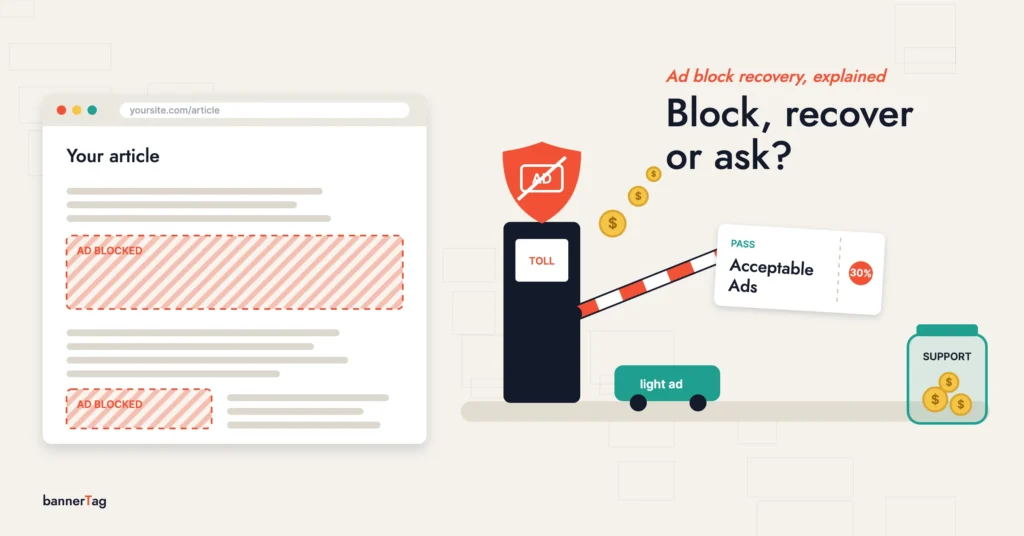
In short: about one in three internet users blocks ads, but how much that costs you depends on your audience. Lifestyle and recipe sites often lose under 5% of pageviews; tech, gaming and ad tech sites can lose a third or more. Ad block recovery tools win some of that back in four ways: lighter "Acceptable Ads", a message asking readers to allow ads, a value exchange (watch an ad, pay or donate), or quietly re-inserting ads. The friendly options recover a modest slice. The aggressive ones recover more and annoy readers. Measure first, fix heavy ads first, and only then pick a tool.
How big is the ad blocking problem in 2026?
Ad blocking is not going away. eyeo, the company behind Adblock Plus, estimates that active ad blocking users passed 1 billion at the end of 2025: about 448 million on desktop (down 4% since 2023) and 629 million on mobile (up 27%). In the US around a third of internet users block ads, and in Germany more than half of desktop users do. The Brave browser, which blocks ads by default, passed 100 million monthly users in October 2025.
Two changes matter for publishers right now:
- Chrome's Manifest V3 switch. Chrome turned off older extensions in 2025, including the full uBlock Origin. Many users moved to uBlock Origin Lite, AdGuard or Brave. Blocking did not stop; it moved.
- Mobile is now the bigger half. Most mobile ad blocking happens in browsers like Brave, Samsung Internet or Opera and in DNS-level blockers. Many recovery tools, including Google's message, only work on desktop.
Your own rate is what counts. Mediavine says most lifestyle sites see ad blocking below 5% of users, while sites with a technical audience see far more. Before buying anything, measure it (see the free method in the plan at the end).
The four ways ad block recovery works
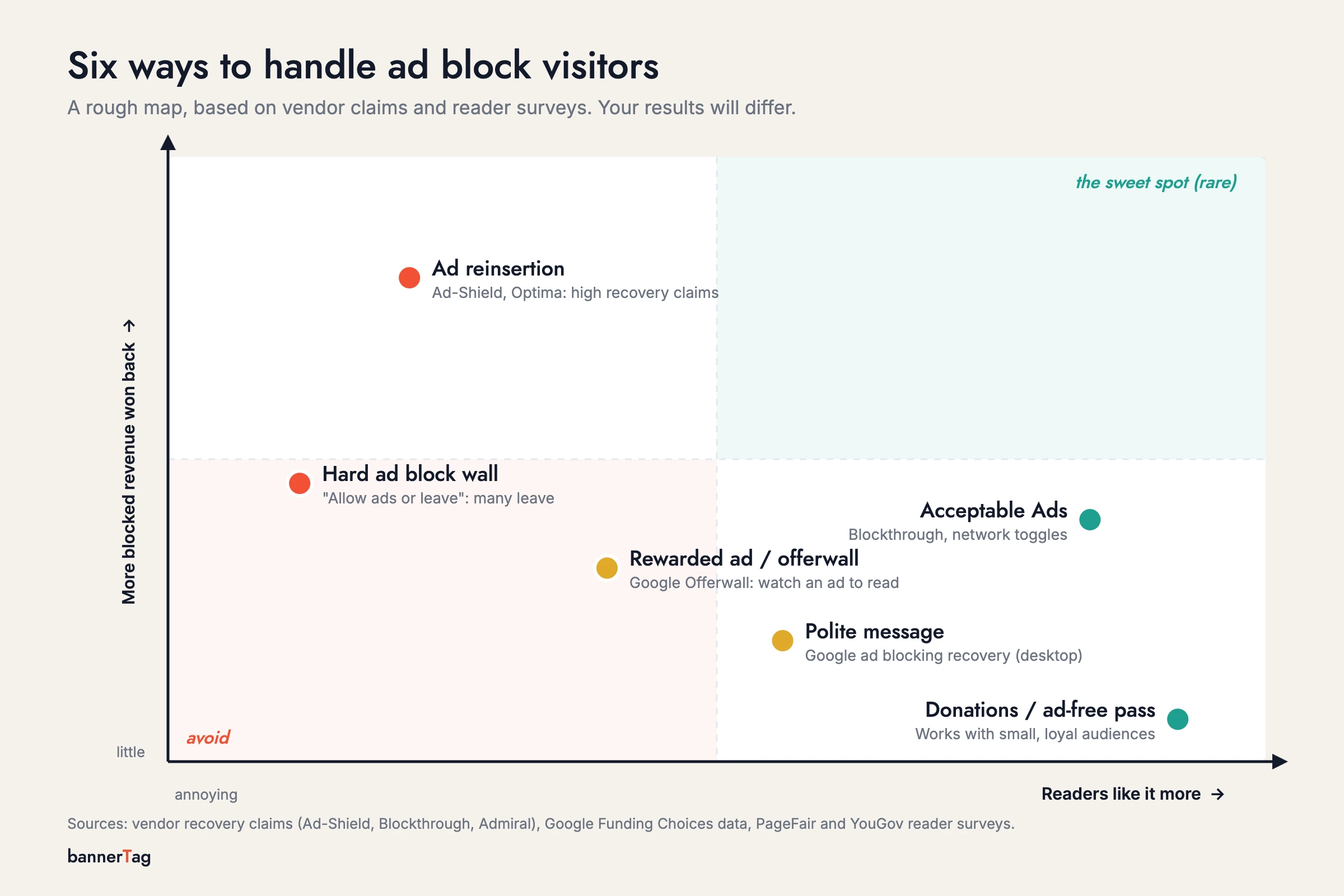
- Acceptable Ads. Many ad blockers, mainly Adblock Plus and AdBlock, let "acceptable" ads through by default: small, static, clearly labelled and not in the way of content. A recovery vendor filters your demand so only compliant ads are served to those users. Readers see a lighter page and are not asked anything.
- Messaging (soft or hard walls). Detect the blocker and ask the reader to allow ads. A soft message can be closed; a hard wall blocks the content until the reader allows ads or leaves.
- Value exchange. Offer another way to support the site: watch one rewarded ad, answer a survey, pay a small amount, subscribe ad-free or donate.
- Ad reinsertion (circumvention). Detect the block and re-insert ads in a way the blocker does not catch, for example by serving them from your own domain or obfuscating the code. This recovers the most, but it goes against what the reader asked for and starts an arms race with filter lists.
The tools, one by one
Blockthrough (Acceptable Ads)
What it does: Blockthrough plugs into your header bidding wrapper and ad server (it works with Google Ad Manager, AdX and most SSPs) and checks every incoming ad in real time against the Acceptable Ads Standard. Users who have ad blockers with Acceptable Ads turned on get a lighter set of ads from your own demand; nobody sees a pop-up.
Setup: a script plus a second ad experience in your ad server, usually done with their team. If you use a network such as Publift, Publisher Collective or Nitro (NitroPay), it may already be available as an add-on.
Who can apply: Blockthrough does not publish a traffic minimum, but it is built for mid-size and large publishers with their own ad stack. Smaller sites usually get it through a partner network.
Cost and results: a revenue share on the extra revenue it brings. Its own FAQ says publishers typically see a 10-20% revenue lift on top of normal revenue, depending on traffic, country, content category and ad blocking rate. Its case studies include Healthline (over $1.1 million recovered since 2018) and CafeMedia (more than $100,000 a month).
The odd part: Blockthrough is owned by an ad blocker company
In November 2022 Blockthrough was bought by eyeo, the German company that makes Adblock Plus and AdBlock, two of the most downloaded ad blockers. eyeo also created the Acceptable Ads program in 2011 and later merged its own Acceptable Ads Exchange (AAX) into Blockthrough.
So the same group sells the tool that blocks your ads and the service that lets some of them back through. Large sites pay for the privilege: publishers that gain more than 10 million ad impressions a month from Acceptable Ads have historically paid about 30% of that extra revenue as a licence fee. eyeo's answer is that users chose to see lighter ads and that small sites join for free. Critics, including competing vendors, call it paying the gatekeeper. Both things are true, and it is worth knowing who you are paying before you sign.
Even eyeo's own CEO has said an Acceptable Ads user is worth about 30% less per thousand impressions than a normal user (quoted by Admiral). Recovered traffic is real money, but cheaper money.
Admiral (messaging plus everything else)
What it does: Admiral calls itself a "visitor relationship management" platform. It detects ad blockers, shows targeted messages (soft or hard), walks readers through allowlisting with step-by-step videos for many blockers, and can also offer subscriptions, donations, email sign-ups and its own Acceptable Ads and ad reinsertion.
Setup: a free tag gives you ad blocking analytics in minutes; recovery is then configured in their dashboard. Who can apply: anyone can sign up. Cost: recovery is performance based; reviews report a cut of about 30% of recovered revenue, and other modules have monthly plans.
Feedback: Admiral publishes many case studies (for example a 70% recovery rate for the community site Blind). Keep in mind that its customers choose how pushy the messages are. Hard walls of any brand put many readers off, so test the soft version first.
Google ad blocking recovery message (free)
What it does: inside AdSense or Ad Manager, under Privacy & messaging > Ad blocking recovery, you can show readers with ad blockers a message asking them to allow ads. It can be dismissible or not, and with "Custom choice" you can add your own option, such as a subscription or donation link.
Setup: add Google's ad blocking tag to the page head (or turn it on in the Site Kit WordPress plugin for AdSense), then create and publish a message. Who can apply: any AdSense or Ad Manager publisher. Cost: free.
Limits: messages only show in desktop browsers, not on mobile. Google also ended its one-click allowlisting, so readers now get instructions instead of a single button. When Google launched the tool as Funding Choices, it reported that on average 16% of visitors allowed ads, with some sites reaching 37%.
Related: Google Offerwall. Offerwall lets readers unlock content by watching a rewarded ad. In AdSense, the rewarded ad is the main choice (email collection is in beta); Ad Manager also offers surveys and small payments through Supertab. It only shows when rewarded ad demand is available.
Ad-Shield (reinsertion for "dark traffic")
Ad-Shield, a newer player, focuses on what it calls dark traffic: visitors whose blockers also hide them from your analytics. It re-inserts ads that follow the Coalition for Better Ads standards and claims a recovery rate above 90%, far higher than Acceptable Ads (which it puts at 15-25%). Freestar and Publift offer it to their publishers. Treat the numbers as vendor claims, and remember that readers who chose a blocker will see ads anyway.
Optima (independent recovery)
Optima (optima.tech), based in Barcelona, sells an independent ad block recovery product for news, entertainment, gaming and streaming publishers in the UK and Europe. It serves a single Acceptable Ads style placement with its own demand, using obfuscation and constantly updated block lists so the ad gets through, and says it reaches over 90% of typical ad block users. Pricing is not public.
Note: if you were looking for Optimera (optimera.nyc), that is a different company. It sells viewability and ad operations automation tools for publishers, not ad block recovery.
Built into your ad network
If you use a managed network, check your dashboard before signing anything. Mediavine has an Ad Block Recovery toggle that serves Acceptable Ads; Playwire combines a recovery message with Acceptable Ads; Publift offers Blockthrough and Ad-Shield, and Freestar pairs its own Freestar Recovered product with Ad-Shield. One switch, no new contracts, and the revenue lands in your normal report.
Comparison table
| Option | How it works | Who can use it, cost | Reader impact |
|---|---|---|---|
| Blockthrough | Acceptable Ads from your own demand; wrapper and ad server setup | Mid-size and large sites, others via a network; revenue share | Low: lighter ads, no message |
| Admiral | Messages, allowlist help and offers, plus AA and reinsertion | Anyone (free tag); about 30% of recovered revenue (reported) | Medium to high, depends on the wall |
| Google ad blocking message | Asks readers to allow ads; optional custom choice | Any AdSense or Ad Manager publisher; free | Medium; desktop only |
| Google Offerwall | Watch a rewarded ad (or pay, in Ad Manager) to read | AdSense and Ad Manager publishers; normal ad share | Medium |
| Ad-Shield | Ad reinsertion, Better Ads compliant | Mid-size and large sites, often via a partner; price not public | Ads appear despite the blocker |
| Optima | Reinserts one Acceptable Ads style placement | News, gaming and media publishers; price not public | Ads appear despite the blocker |
| Network toggle | Acceptable Ads, sometimes plus a message (Mediavine, Playwire) | That network's publishers; included in its share | Low |
| Donations / ad-free pass | Ask readers to pay instead (Ko-fi, Buy Me a Coffee, memberships) | Anyone; about 0-5% fee plus card fees | Low, if not forced |
Do they actually work? What the feedback says
Most of the evidence comes from the vendors themselves, so read it as a best case:
- Acceptable Ads: Blockthrough says 10-20% revenue lift on average. Rivals say Acceptable Ads only recovers 15-25% of the blocked revenue, because it reaches just the users of participating blockers (mainly Adblock Plus and AdBlock) who keep the setting on. uBlock Origin, Brave and DNS blockers do not take part.
- Messages: Google reported an average of 16% of readers allowing ads. Blockthrough puts message conversion at about 10-15%. Loyal audiences do better: in a Financial Times test with registered readers, 40% allowed ads when simply asked.
- Walls: in a PageFair survey, 74% of US ad blocking users said they would rather leave a site than switch off their blocker at a wall.
- Reinsertion: the highest numbers on paper, but in a YouGov survey 83% of US adults said they would be annoyed if a site disabled their ad blocker without asking, and 61% said they would not return.
Independent, long-term results are rare. If a vendor quotes a recovery rate, ask what it is measured against (all blocked pageviews, or only the ones it can see), and run a test with a control group before rolling it out.
What about user experience?
People mostly block ads because of bad ads: pop-ups, autoplay video with sound, ads that move the page. When asked, many say they would accept lighter ads. That points to a simple order of work:
- Fix your own ads first. Fewer, better placed ads keep more readers from installing a blocker in the first place. See where to place ads on your website.
- Never break the page. A wall on the first visit, on a search landing page, punishes a reader who does not know you yet.
- Be honest. One short, friendly message that explains why ads matter works better than a guilt trip.
- Avoid surprises. Re-inserting ads a reader blocked may earn money today and lose the reader tomorrow.
Should publishers use ad block recovery at all?
It depends on how many of your readers block ads and how loyal they are:
- Under about 10% blocked (most lifestyle, recipe, local and news sites): the money at stake is small. Turn on Acceptable Ads if your network offers a toggle and move on.
- 10-30% blocked (tech, gaming, finance, B2B): use Acceptable Ads plus a soft, dismissible message on desktop. Add a "support us" option for regulars.
- Above 30% (developer, gaming and ad tech audiences): recovery is worth a proper test. Combine Acceptable Ads with a polite message, and consider a value exchange such as a rewarded ad or an ad-free membership. Be careful with walls and reinsertion: this audience leaves fast and talks about it.
- Small site with loyal readers: skip paid tools. A short note and a Ko-fi or Buy Me a Coffee link may earn more than recovered ads.
One legal note for EU sites: detecting an ad blocker reads information from the visitor's browser, and some argue that needs consent under the ePrivacy rules, the same as cookies. IAB Europe's advice has been to cover ad block detection in your privacy policy and consent tool. This is not legal advice; ask your lawyer if you plan to use walls.
Donations and subscriptions instead?
Asking for direct support is the gentlest option, and it suits sites with a community. Buy Me a Coffee takes a 5% platform fee (plus card fees). Ko-fi takes no fee on one-time tips in its free plan and offers a paid plan for memberships. For an ad-free pass you can use a membership plugin, or Google's Offerwall with Supertab in Ad Manager.
Be realistic: only a small share of readers ever pays, so donations rarely replace ad revenue on a large, search-driven site. They work best as an extra option inside your ad block message, not instead of ads.
A simple plan for the next 30 days
- Measure. Add Google's ad blocking recovery tag and create a message, but leave it in draft. AdSense or Ad Manager will then report your ad blocking rate for free.
- Fix heavy ads. Remove the worst placements and anything that shifts the page.
- Turn on Acceptable Ads if your network has a toggle, or talk to Blockthrough if you run your own stack.
- Publish a soft desktop message with one extra option (support, newsletter or ad-free pass).
- Review after 30 days: allowlist rate, bounce rate of readers with blockers, and revenue per session. Keep what works; drop anything that hurts returning visits.
If you are working out what the recovered traffic is worth, the ad revenue calculator gives a quick estimate, and the Publisher Guide covers the rest of the monetization basics. Have a specific ad block question? Ask AdOps.
FAQ
Is ad block recovery legal?
Showing a message or Acceptable Ads is common and widely accepted. In the EU, ad block detection may need consent under the ePrivacy rules, so mention it in your privacy policy and consent setup. Re-inserting ads a user blocked carries more legal and reputational risk. This is not legal advice.
Does Google's ad blocking recovery message work on mobile?
No. Google shows ad blocking recovery messages only in desktop browsers, not in mobile browsers or apps.
Can a small website use Blockthrough?
Blockthrough does not list a minimum, but it is aimed at publishers with their own ad stack. Small sites usually get Acceptable Ads through their ad network instead, for example with a toggle in the dashboard.
Does Acceptable Ads work with uBlock Origin or Brave?
No. Acceptable Ads only reaches users of ad blockers that take part in the program, mainly Adblock Plus and AdBlock, and only if they keep the setting on (it is on by default). uBlock Origin, Brave and most DNS blockers do not show Acceptable Ads.
Who owns Blockthrough?
eyeo, the company behind Adblock Plus and AdBlock, bought Blockthrough in November 2022. eyeo also created the Acceptable Ads program.
How much revenue can I recover?
Vendors quote anything from 10-20% extra revenue (Acceptable Ads) to over 90% of blocked impressions (reinsertion). In practice it depends on your ad blocking rate, your audience and how pushy you are willing to be. Measure your rate first, then test one method at a time.
Sources
- eyeo: Ad-blocking report 2026
- eyeo acquires Blockthrough (Nov 8, 2022)
- AdExchanger: eyeo, owner of Adblock Plus, acquires Blockthrough
- Blockthrough: the 3 types of ad block recovery strategies
- Google Ad Manager Help: About ad blocking recovery messages
- Google AdSense Help: ad blocking recovery messages
- Google: Helping publishers recover lost revenue from ad blocking
- Google AdSense Help: Offerwall
- State of Digital Publishing: Admiral review
- Ad-Shield: ad block recovery strategies
- Ultimate Asset: Optima technology spotlight
- Mediavine Help: Ad Block Recovery
- YouGov: reactions to sites disabling ad blockers
- IAB Europe: ad blocking detection guidance