
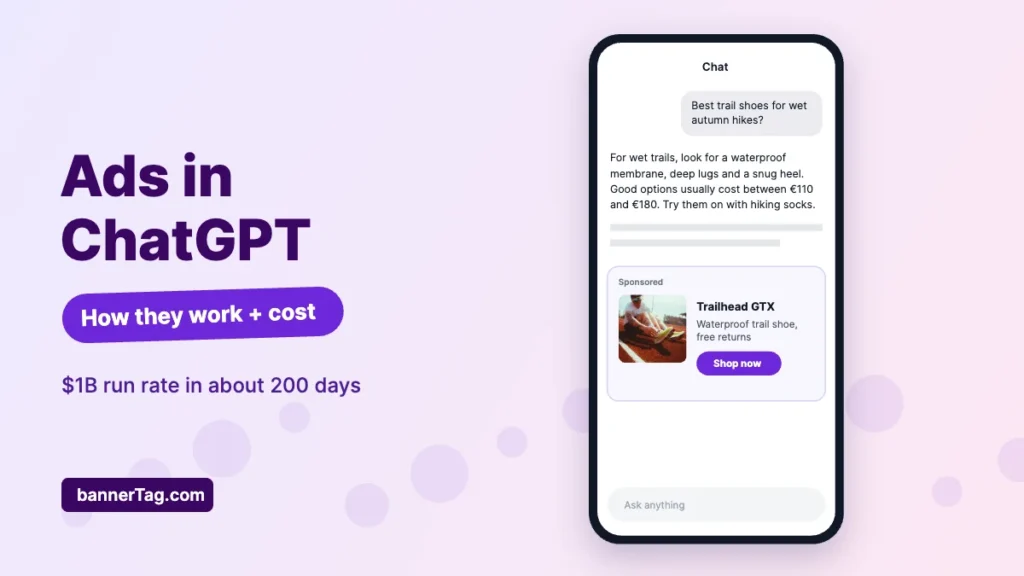
Since early 2026, ChatGPT shows ads. For advertisers it is a new place to reach people at the exact moment they ask for advice. For publishers it is one more reason to pay attention to how AI answers change where people click and where ad budgets go.
This guide explains how ChatGPT ads work, what they cost, the early performance data, how they compare with Google's ads in AI answers and what it all means for advertisers and publishers.
Short version: ChatGPT ads appear under answers for adult users on the Free and Go plans, are labeled Sponsored and, according to OpenAI, do not change the answer. Advertisers can buy them self-serve since May 2026, paying per click or per 1,000 impressions. They reached a $1 billion annual run rate within about 200 days. Early click rates are under 1% in most markets, and measurement is still young, so test with a small budget and clear tracking.
How ChatGPT ads work
| Question | Answer |
|---|---|
| Who sees ads? | Logged-in adults on the Free and Go plans. Plus, Pro, Business and Enterprise users see no ads |
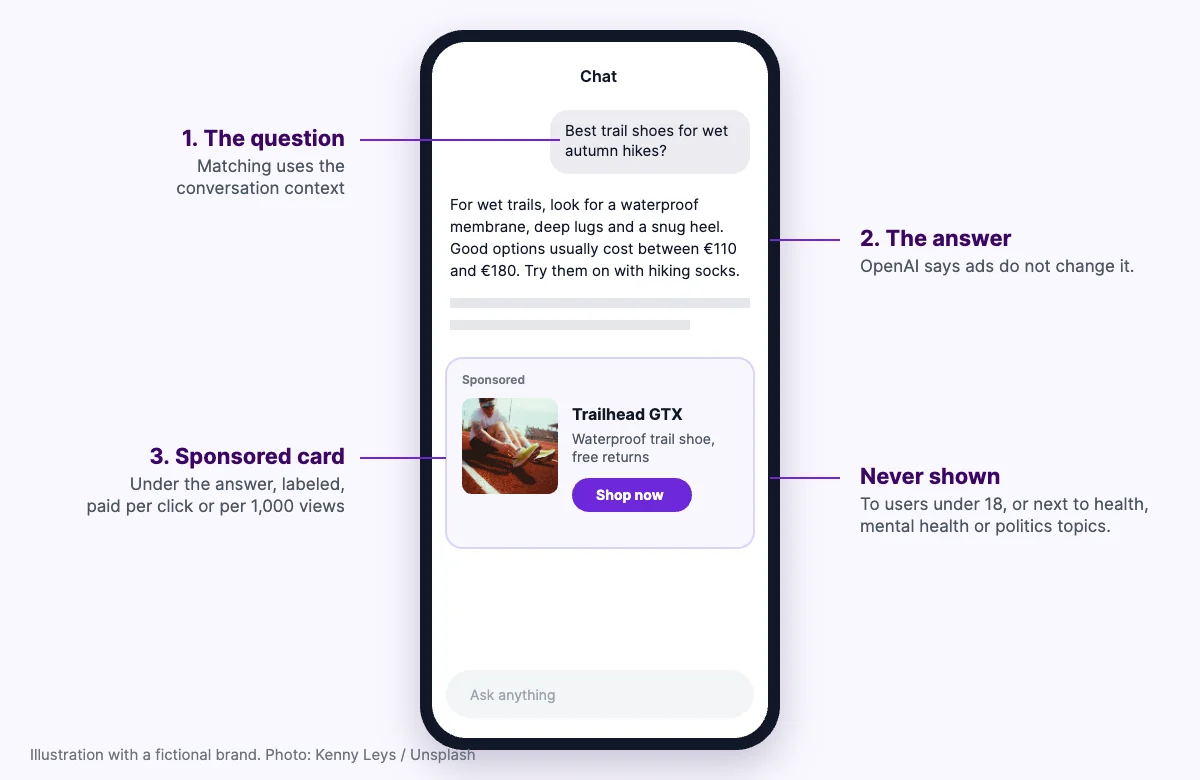
| Where do they appear? | Under the answer, when a relevant sponsored product or service exists, clearly labeled and separate from the answer |
| Who never sees ads? | Users who say they are under 18 or that OpenAI predicts are under 18 |
| Which topics are excluded? | Sensitive or regulated topics such as health, mental health and politics |
| Do ads change the answer? | OpenAI says no: answers stay independent and conversations are not shared with advertisers |
| How are ads matched? | By the context of the conversation, plus "context hints" the advertiser provides. In Europe ads were not personalized at launch |
Timeline: from test to $1 billion
| Date | What happened |
|---|---|
| January 16, 2026 | OpenAI announces ad tests for US adults on Free and Go plans |
| February 2026 | Pilot opens to selected brands, reportedly at about $60 CPM with high minimum budgets |
| April 2026 | Reported CPMs fall to around $25 as more advertisers join |
| May 5, 2026 | Self-serve Ads Manager (beta), cost-per-click bidding, Conversions API and pixel. Buying also through agencies and partners such as Criteo and StackAdapt |
| July 2026 | Adthena counts 7,378 advertisers in one week, led by travel and B2B software |
| August 31, 2026 | OpenAI says ads reached a $1 billion annualized run rate, in 40+ countries |
| Autumn 2026 | More than 60 countries listed for Ads Manager, and brand-safety tools being added |
What do ChatGPT ads cost?
You can bid per click (CPC) or per 1,000 impressions (CPM). There is no published minimum budget for self-serve. Reported prices so far:
- CPM: started around $60 in the pilot and dropped to about $25 within two months, as supply grew.
- CPC: reported between about $3 and $22, depending on the topic. Expensive categories such as finance and software sit at the top.
For comparison, the median Google search click in the US cost $5.42 in 2026. Prices on ChatGPT will keep moving as more advertisers join, so check the auction yourself rather than relying on early reports.
Early performance data
The best public data so far comes from Similarweb and Graphite, who analyzed more than 95,000 US ChatGPT ads (report published September 2026):
| Market | Click-through rate (March to September 2026) |
|---|---|
| Brazil | 1.91% |
| Mexico | 1.55% |
| Japan | 1.53% |
| United Kingdom | 0.74% |
| United States | 0.73% |
| Canada | 0.75% |
| Australia | 0.67% |
- About 43% of ad-eligible US users had seen an ad by September 2026.
- Ads early in a conversation (first four turns) got about 48% higher click rates than later ones.
- B2B software was the biggest category, with about 20% of US ad impressions.
- Click rates roughly doubled from launch to autumn as advertisers improved their ads.
Keep in mind: these are panel estimates, there is little public data on conversions, and some agencies have reported weak results. Treat ChatGPT as a test channel, not a replacement for search.
ChatGPT ads vs ads in Google's AI answers
| ChatGPT ads | Google AI Overviews and AI Mode | |
|---|---|---|
| Where | Under ChatGPT answers | Inside or under Google's AI answers in Search |
| How to buy | OpenAI Ads Manager or partners | Existing Google Ads campaigns (Search, Performance Max, AI Max) |
| Targeting | Conversation context and context hints | Google's keywords, AI matching and audience signals |
| Measurement | Conversions API and pixel, still young | Full Google Ads and GA4 reporting |
| Scale | Hundreds of millions of weekly users, fewer advertisers | Google Search scale |
If you already run Google Ads, you may already appear in AI Overviews. ChatGPT is a separate buy with its own learning curve. See what is Google Ads.
How to start advertising on ChatGPT
- Set one goal (leads, sales or sign-ups) and install conversion tracking first.
- Write like a helpful answer, not a slogan. People are in the middle of a conversation. Clear benefits and specifics work better than hype.
- Use context hints that describe the problems your product solves, the way people ask about them.
- Match the landing page to the question. Someone asking "best budget CRM for a 5-person team" should land on that answer, not your homepage.
- Start small with CPC, run for at least two to four weeks and compare cost per result with search and social.
- Watch brand safety and placements as the tools improve.
Measure it properly with our guide on how to measure the success of an advertising campaign, and tag links with the UTM builder.
What ChatGPT ads mean for publishers
For website owners this is the more important part of the story.
- Fewer clicks from questions. When people get answers inside ChatGPT or Google's AI answers, fewer of them visit websites. See how AI search affects publishers.
- Budgets follow attention. A $1 billion run rate is money that partly comes from search, social and the open web. Expect more competition for performance budgets.
- Context still sells. AI ads are sold on conversation context, which is the same thing good publisher pages offer. Clean, topic-focused pages with strong engagement stay attractive to buyers, especially in private deals.
- Your content feeds the answers. Decide how AI crawlers may use your site, and keep your ads.txt and sellers.json clean so buyers who stay on the open web find you. See the ads.txt and sellers.json guide.
- Direct relationships matter more. Newsletters, communities and loyal readers are traffic no AI answer can take away.
Frequently asked questions
Does ChatGPT have ads?
Yes. Since early 2026 ChatGPT shows sponsored ads under some answers for logged-in adults on the Free and Go plans. Paid plans such as Plus, Pro, Business and Enterprise are ad-free.
How much do ChatGPT ads cost?
Advertisers bid per click or per 1,000 impressions. Reported CPMs fell from about $60 in the pilot to around $25, and reported CPCs range from about $3 to $22 depending on the topic.
How do I advertise on ChatGPT?
Use OpenAI's self-serve Ads Manager (available since May 2026 and rolling out by country) or buy through partner agencies and ad tech platforms. Set up conversion tracking first.
Do ads influence ChatGPT's answers?
OpenAI says no. Ads are labeled Sponsored, shown separately from the answer, and advertisers do not get access to conversations.
Are ChatGPT ads shown to children?
No. OpenAI says ads are not shown to users who say they are under 18 or are predicted to be, and not next to sensitive topics like health, mental health or politics.
Sources
- OpenAI: New ways to buy ChatGPT ads (May 5, 2026)
- PPC Land: ChatGPT opens ads to users (January 2026)
- PPC Land: ChatGPT ads pass a $1 billion run rate (September 2026)
- PPC Land: Similarweb and Graphite ChatGPT ads report (October 2026)
- PPC Land: Adthena counts 7,378 ChatGPT advertisers (July 2026)
- Search Engine Land: ChatGPT ads are growing fast
- WordStream: Google Ads benchmarks 2026
Updated November 26, 2026.