
Ten years ago, "TV advertising" meant a 30-second spot on a cable channel. Today almost half of all TV time in the US is spent on streaming apps on a smart TV, a streaming stick or a console. That is connected TV, or CTV, and it is where most of the growth in TV advertising now happens.
For website publishers this raises three fair questions. Is the money really moving there? Who gets it? And is our own inventory losing out because the budgets end up inside a few walled gardens? This article answers all three with current data and ends with practical steps you can take.
Short version: yes, viewing and ad money keep moving to CTV. The winners are a small club: YouTube first, then Amazon, Netflix, Disney, Roku and the big TV groups. Most CTV money comes out of linear TV budgets, not out of web display, but web video now competes with cheaper, more plentiful CTV ads. Publishers win by keeping their web video strong, selling their data and context, putting their own video on the TV screen (YouTube, FAST channels) and keeping a clean supply chain.
What counts as CTV?
CTV is any TV screen that streams video over the internet: smart TVs (Samsung, LG, TCL, Hisense), streaming devices (Roku, Amazon Fire TV, Google TV, Apple TV) and game consoles. The ads run inside apps such as YouTube, Prime Video, Netflix, Hulu, Tubi or Pluto TV.
You will also see the term OTT (over the top). OTT means the content (video streamed over the internet), CTV means the screen. In ad tech the two words are often used for the same thing. When people talk about CTV advertising they usually mean full-screen video ads on the living room TV, sold either directly by the app or through programmatic deals.
Is more traffic going to CTV?
Yes, both viewing time and ad money keep moving to streaming.
Viewing time
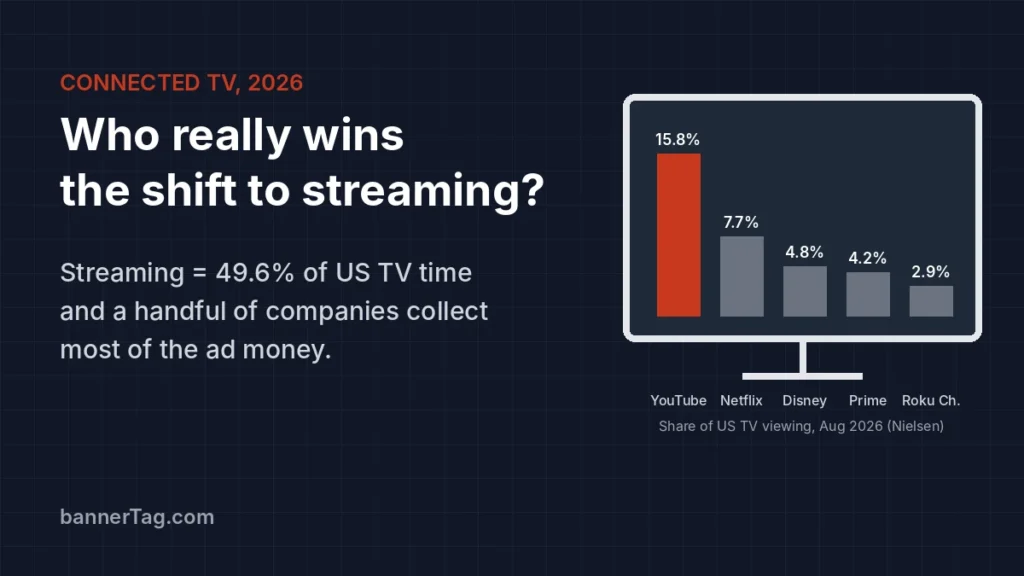
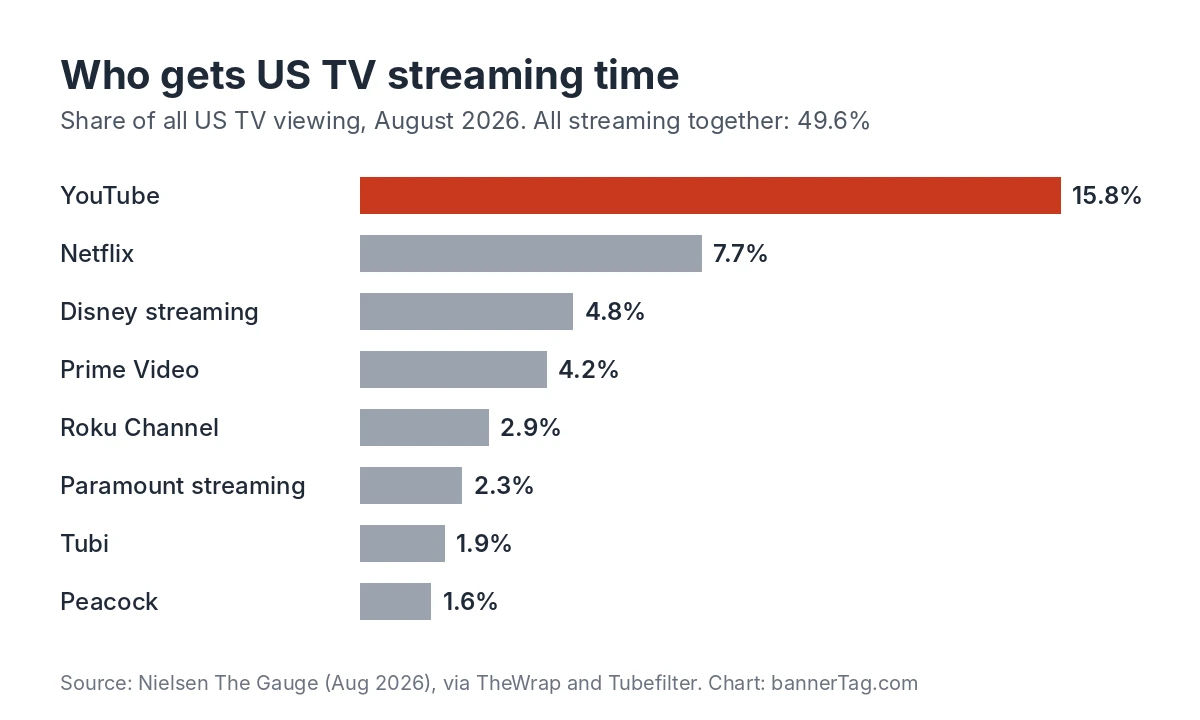
Nielsen's monthly report The Gauge tracks how Americans spend their TV time. In August 2026 streaming reached 49.6% of all TV viewing. Cable had 18.9% and broadcast 17.5%. In other words, streaming alone now gets more TV time than cable and broadcast put together, minus a few points. Note that Nielsen changed its method from September 2026, so later months are not directly comparable.
| Platform (US, Aug 2026) | Share of all TV viewing |
|---|---|
| YouTube (main app, on TV) | 15.8% (record) |
| Netflix | 7.7% |
| Disney streaming (Disney+, Hulu, ESPN+) | 4.8% |
| Prime Video | 4.2% |
| The Roku Channel | 2.9% |
| Paramount streaming (Paramount+, Pluto TV) | 2.3% |
| Tubi (Fox) | 1.9% |
| Peacock | 1.6% |
| All streaming | 49.6% |
| Cable | 18.9% |
| Broadcast | 17.5% |
Ad money
The money follows the viewers, a bit more slowly. EMARKETER expects US CTV ad spend of about $37 billion in 2026 and about $59 billion by 2030. Forecasts differ: some put 2026 growth near 19%, others near 14%. All of them agree on one thing: growth is slowing because the US market is getting close to full, while countries like India, Brazil and Spain are growing faster.
Globally, WARC data quoted by EMARKETER says linear TV has fallen to just 12% of all ad spending, and CTV is on track to take more than 40% of TV ad money by 2030. So the trend is clear. The question is who collects it.
Who are the real winners?
It is not only YouTube, but it is a short list. Most CTV money goes to a handful of companies that own either the most watched apps, the TV operating systems or the buying platforms. Often they own two of the three.
1. YouTube
YouTube is the biggest TV channel in America. Its 15.8% share in August 2026 is about twice Netflix's. People now watch creator videos, podcasts and live sports (NFL Sunday Ticket) on the big screen, and viewing by people over 50 is growing fast. YouTube sells this through Google Ads and Display and Video 360, with its own data and its own measurement. Very little of it touches the open market.
2. Amazon
Amazon is the quiet winner. In 2024 it switched on ads for all Prime Video users by default, so it got a huge ad-supported audience overnight. EMARKETER says Prime Video reaches over 315 million ad-supported viewers worldwide. Amazon also owns Fire TV and, most important, a DSP (demand-side platform) that now sells other companies' CTV inventory too: Roku (over 80 million US households), Netflix in more than a dozen markets and Disney through its DRAX exchange. Amazon's ad revenue grew 23% in Q4 2025, faster than the CTV market, while its main rival in independent ad buying, The Trade Desk, slowed to 14% growth.
3. Netflix
Netflix came late to ads but is growing quickly. Its ad revenue was about $1.5 billion in 2025 and the company expects it to roughly double to about $3 billion in 2026. In May 2026 it said its ad tier reaches more than 250 million monthly active viewers (under a new counting method) and it plans to launch the ad tier in 15 more countries from 2027.
4. Roku, Disney and the TV groups
Roku is a gatekeeper. It owns the operating system on many TVs, The Roku Channel and the home screen, and app owners often have to give the platform part of their ad inventory to be carried. Fox has agreed to buy Roku for about $22 billion, with closing expected in the first half of 2027. Disney (Hulu and Disney+), NBCUniversal (Peacock), Paramount (Paramount+ and Pluto TV) and Fox (Tubi) round out the top tier. TV makers such as Samsung and LG also run their own free channels and ad businesses.
EMARKETER puts Amazon, Disney, Google (YouTube) and Roku in the top tier, each with more than $3 billion in US CTV ad revenue. It also notes that budgets are being concentrated among fewer players. HBO Max, by comparison, has only about 1.5% of US CTV ad spend.
| Winner | What it owns | How it sells ads |
|---|---|---|
| YouTube (Google) | Most watched TV app | Own tools (Google Ads, DV360), own data and measurement |
| Amazon | Prime Video, Fire TV, Amazon DSP | Own DSP, also resells Roku, Netflix and Disney inventory |
| Netflix | Ad tier with 250M+ viewers | Direct, upfronts and selected DSPs |
| Roku (Fox, pending) | TV operating system, Roku Channel | Direct, own platform, Amazon DSP and others |
| Disney, NBCU, Paramount, Fox | Big streaming apps and FAST services | Upfronts, own exchanges, private deals |
| Smaller apps and FAST channels | Content only | Open exchange and private deals through SSPs |
Is publisher inventory suffering?
The honest answer: some pressure, but not a collapse. Here is how it works.
Most CTV money comes from TV, not from the web
The biggest source of CTV budgets is old linear TV. Brands that used to buy cable spots now buy streaming. So when CTV grows, it is mostly cable and broadcast that lose. Display banners on websites are bought by different teams for different goals (performance, retail, reach), and those budgets did not move to the TV in the same way.
But web video competes with CTV now
The overlap is video. A brand with a video budget can buy pre-roll on a website or a full-screen, non-skippable ad on a 55 inch TV. Many choose the TV. At the same time CTV supply keeps growing: Prime Video added ads for all users, Netflix keeps adding viewers and FAST channels multiply. EMARKETER notes that streaming CPMs are flattening as supply grows. When the premium option gets cheaper, buyers have less reason to pay for weaker web video, especially small outstream players that are rarely seen or heard.
Walled gardens keep the data inside
The largest CTV sellers sell through their own tools. They know who is logged in, what they bought (Amazon) and what they watched. They offer buyers private deals and in Amazon's case zero fees on its own guaranteed deals. Independent publishers cannot match that data, and buyers who move budget into these closed systems spend less in the open market.
Open CTV has its own problems
This is where web publishers have an edge. Open-market CTV is often hard to check. Buyers usually see only the app name, not the show. And fraud is a real issue: DoubleVerify says CTV fraud schemes grew 140% in Q1 2026 compared to a year earlier, and it found ten times more fraudulent CTV apps in 2025 than in 2024. A website page, by contrast, has a URL, visible content and many ways to check viewability. That transparency is something to sell.
Bottom line: CTV mostly eats linear TV. For web publishers the risk is concentrated in video, where buyers now have a cheaper big-screen option, and in the general shift of brand budgets into a few closed platforms.
How to benefit from CTV as a publisher
You do not need your own TV app to benefit. Pick the steps that fit your size and your video library.
1. Make your web video worth buying
If web video has to compete with TV, it must be real. Play it in a visible spot, with real content, sound on where users expect it, and fewer players per page. Sell it through video header bidding so many buyers compete, and track viewability and completion rates. Poor outstream units drag your whole video CPM down.
2. Sell what CTV lacks: context and first-party data
CTV buyers struggle to know what content their ads ran next to. You know exactly which article, topic and audience each impression belongs to. Package that in private deals (PMPs), for example "in-market car buyers" or "finance readers". Many brands that buy CTV want to reach the same people again on mobile and desktop, so offer your audience as the follow-up step after a TV campaign.
3. Put your video on the TV through YouTube
YouTube is where most TV streaming time happens, and it is open to anyone. A growing share of YouTube views now happens on TV screens. The New York Post says its YouTube views are up 66% and its YouTube revenue nearly quadrupled in a year. Long videos, series and podcasts work well on TV. You keep a share of the ad revenue without building any tech.
4. Launch a FAST channel if you have a video library
A FAST channel (free ad-supported streaming TV) is a 24/7 linear channel on services such as Samsung TV Plus, The Roku Channel, Pluto TV, Tubi or LG Channels. Publishers are moving in: Business Insider launched one with Magnite's SpringServe running ad sales, and the New York Post started one in 2026 with about 150 hours of programming, refreshing about 20% each month through a managed service. USA Today and Billboard have channels too.
You need a real library (100+ hours is a sensible starting point), rights to all of it and a partner for scheduling, distribution and ad sales. Revenue is shared with the platform and the partner, so treat it as an extra channel, not a fast win.
5. Keep your supply chain clean
Buyers in CTV and on the web both prefer short, direct paths. Keep your ads.txt, app-ads.txt and sellers.json up to date, remove partners you no longer use and avoid long reseller chains. If you sell video or CTV through several partners, check how many SSPs you really need. Clean supply is easier for buyers' supply path optimization to pick.
6. Do not build a CTV app unless you are big
A CTV app costs money to build for each platform (Roku, Fire TV, Samsung, LG, Google TV, Apple TV), needs ongoing content and has to win a spot on crowded home screens. For most publishers YouTube and FAST channels give TV reach for a fraction of the cost.
| Your situation | What to do first |
|---|---|
| Text site, little or no video | Focus on display quality and data deals. Add video only where it fits the content. |
| Some original video | Video header bidding on your site, plus a serious YouTube channel. |
| Large video library (100+ hours) and rights | Add a FAST channel through a managed partner. |
| Big brand with millions of video viewers | Consider your own CTV app and direct CTV sales. |
What to watch in 2027
- Fox and Roku: if the deal closes, Fox would control both a big FAST service (Tubi) and a major TV operating system.
- Netflix's ad tier in 15 more countries, which adds a lot of premium supply in Europe and Asia.
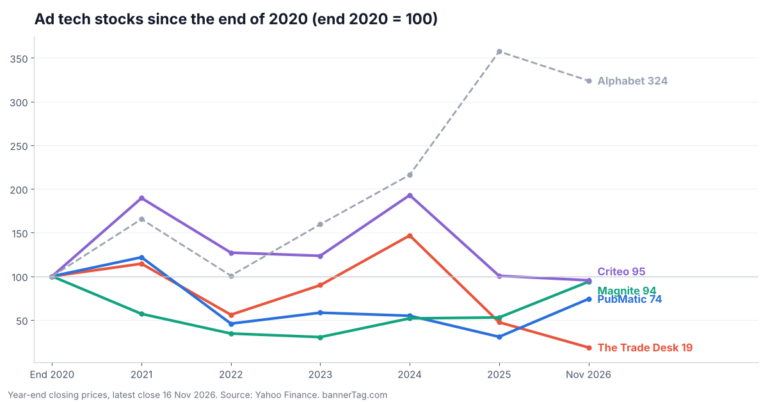
- Amazon vs The Trade Desk: whether more CTV buying moves into Amazon's DSP. See our ad tech stocks analysis and live prices on Programmatic Pulse.
- Show-level reporting: buyers keep asking CTV sellers for more transparency. The more CTV opens up, the more it competes with web video on quality, not just screen size.
- Smart TV data: ACR data from smart TVs is what lets TV makers sell targeting and measurement.
Frequently asked questions
What is CTV advertising?
CTV advertising means video ads shown on internet-connected TV screens, such as smart TVs, streaming sticks and game consoles. The ads run inside streaming apps like YouTube, Prime Video, Netflix, Hulu, Tubi and Pluto TV.
Is streaming bigger than cable and broadcast TV?
Yes. In August 2026 streaming had 49.6% of all US TV viewing time according to Nielsen, more than cable (18.9%) and broadcast (17.5%) on their own.
Who earns the most from CTV ads?
A few large companies. YouTube has the biggest share of TV viewing (15.8% in August 2026). Amazon, Disney, Google and Roku each earn more than $3 billion a year in US CTV ad revenue, and Netflix expects about $3 billion in ad revenue in 2026.
Does CTV take ad money away from websites?
Mostly it takes money from linear TV. The pressure on websites is mainly in video, where buyers can now choose full-screen TV ads, and in brand budgets that move into closed platforms like Amazon and YouTube.
Can a small publisher make money from CTV?
Yes, without building a TV app. The easiest ways are a YouTube channel (much YouTube viewing happens on TVs) and, if you own enough video, a FAST channel run by a managed partner. You can also sell your web audience to brands as a follow-up to their CTV campaigns.
What is a FAST channel?
FAST stands for free ad-supported streaming TV. It is a 24/7 scheduled channel on services like Samsung TV Plus, The Roku Channel, Pluto TV or Tubi. Viewers watch for free and the channel earns money from ads.
Sources
- TheWrap: Nielsen The Gauge, August 2026 (streaming 49.6%, YouTube 15.8%)
- Tubefilter: YouTube's record share of US TV watch time
- EMARKETER: Global CTV ad spend forecast (US 2026 and 2030)
- EMARKETER: CTV becomes TV's growth engine as linear collapses (WARC data)
- EMARKETER: FAQ on CTV advertising in 2026 (platform tiers, Prime Video reach)
- AdExchanger: Why Amazon is gaining ground in CTV (March 2026)
- AdExchanger: Netflix doubled its ad revenue (January 2026)
- Variety: Netflix ad tier reaches 250 million viewers (May 2026)
- Motley Fool: Amazon partners with Netflix (Roku and Disney deals)
- AdExchanger: CTV is less transparent than YouTube
- DoubleVerify: CTV fraud schemes surge 140% (May 2026)
- PPC Land: Business Insider builds its own FAST channel
- Axios: New York Post launches its first FAST channel
Data checked on November 26, 2026.