

For twenty years, the deal between Google and publishers was simple. You create content, Google shows a link, and readers click through to your site, where you show ads. AI search is changing that deal. AI Overviews, AI Mode and chatbots like ChatGPT now answer many questions directly, so fewer people need to click.
So how big is the AI search impact on publishers, their traffic and their ad revenue in 2026? And what can you do about it? In this article we look at the latest data and give you a practical plan.
What changed in search
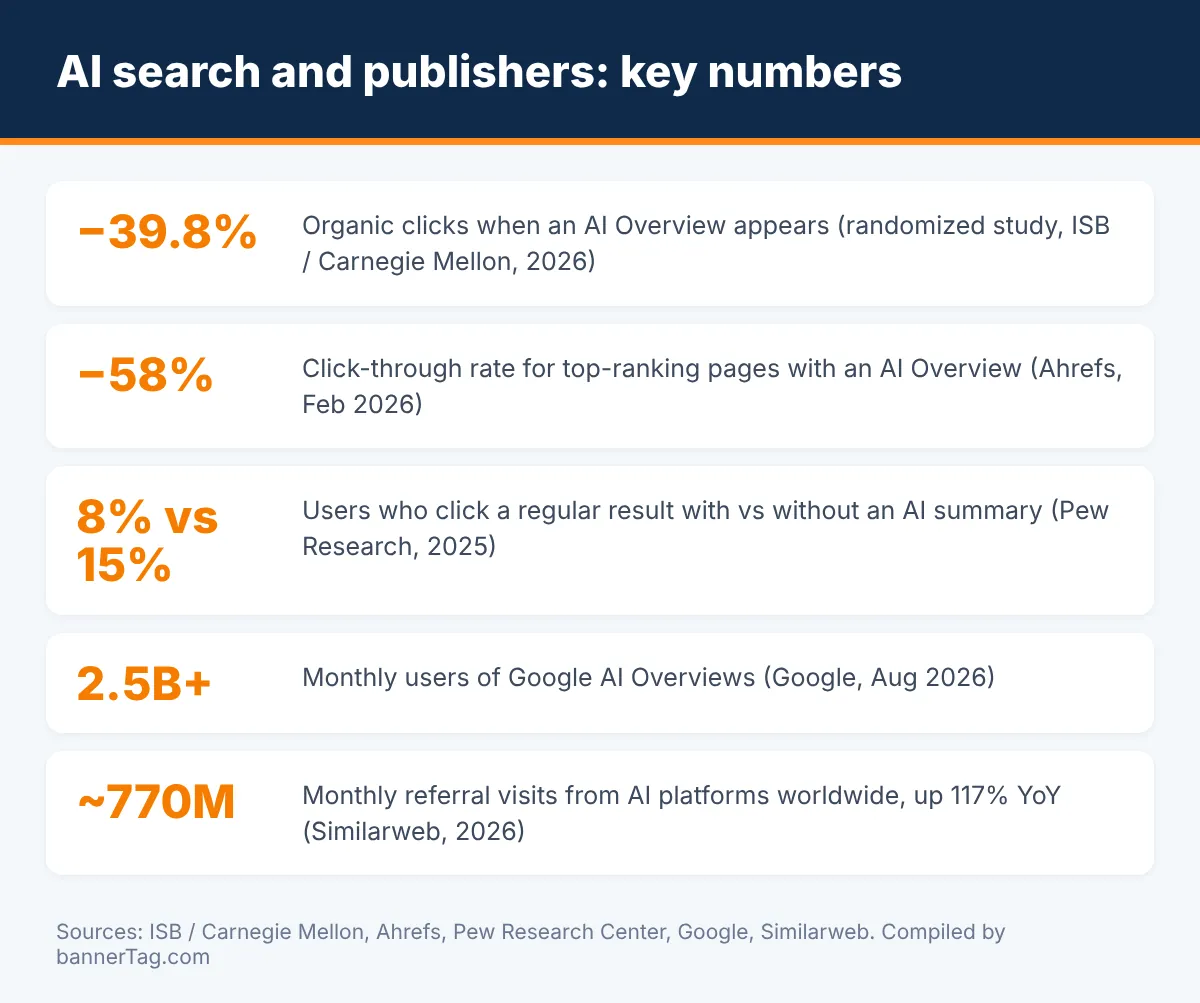
Google started showing AI Overviews in the US in May 2024. Since then they have spread to more countries, languages and query types. According to Google’s own figures, AI Overviews now reach more than 2.5 billion users a month, and AI Mode, the chat-style search tab, has more than 1 billion monthly users.
At the same time, more people search inside AI assistants. ChatGPT, Gemini, Perplexity and Claude all browse the web and summarize it. As a result, a growing share of searches end without a click to any website.
What the data shows
Many studies have measured the effect. They use different methods, so the exact numbers differ. However, they all point in the same direction.
| Study | What it found |
|---|---|
| Agarwal & Sen (ISB / Carnegie Mellon), 2026 | Organic clicks fell 39.8% when an AI Overview appeared; zero-click searches rose 34.5%. This was a randomized experiment with 1,065 US users. |
| Ahrefs, February 2026 | 58% lower click-through rate for top-ranking pages when an AI Overview is shown, up from 34.5% in its 2025 study. |
| Pew Research Center, 2025 | Users clicked a regular result 8% of the time with an AI summary, compared with 15% without one. Only 1% clicked a link inside the summary. |
| Seer Interactive, 2025 | Organic CTR on queries with AI Overviews fell 61%. However, brands cited inside the overview got 35% more organic clicks than those left out. |
| Advanced Web Ranking, July 2026 | Position 1 CTR dropped from 20% to 9.7% on desktop and from 35.7% to 12% on mobile when an AI Overview was present. |
In other words, if a query shows an AI Overview, the top organic result can lose roughly half of its clicks. In addition, the effect is strongest for simple informational questions, such as definitions, quick facts and how-to basics.
Which publishers are hit hardest
- Definition and quick-answer sites. If the answer fits in three sentences, the AI gives it directly.
- Recipe, health and how-to content with very similar articles across many sites.
- Small and mid-size publishers that depend on Google for most of their traffic. Chartbeat data, as reported by PPC Land, suggests small publishers lost a large share of search traffic over two years.
- Affiliate and listicle sites that summarize products without original testing.
On the other hand, some content is more resistant. Tools and calculators, original research, opinion, breaking news, forums and content with a strong brand still earn clicks, because an AI summary cannot replace the experience.
What it means for ad revenue
Ad revenue is simple math: pageviews × page RPM ÷ 1,000. AI search mainly hits the first part. Fewer clicks mean fewer pageviews, so total revenue falls even if your RPM stays the same. (If you want a refresher on the metrics, read RPM vs CPM vs eCPM.)
However, there is a second effect. The visitors who still click often want more than a quick answer. They read longer and visit more pages. As a result, revenue per visitor can improve even while total sessions drop. Publishers who adapt focus on that: earning more from every visit instead of chasing every click.
There is also a new traffic source. Similarweb data shows AI platforms sent around 770 million referral visits a month worldwide between mid-2025 and mid-2026, more than double the year before. ChatGPT drives about 95% of that, according to BrightEdge. For most sites it is still small, but it is growing fast and the visitors are often highly engaged.
Your new controls: opting out of AI features
In 2026 the UK Competition and Markets Authority required Google to let publishers opt out of AI features without losing regular search visibility. In response, Google added a Search generative AI control to Search Console. It started with UK sites in June, expanded during the summer and, according to industry reports, reached all sites by the end of August 2026.
If you exclude your site, Google will no longer use it for AI Overviews, AI Mode or Discover’s generative AI features, including as a link. Google says the setting is not a ranking signal for regular results. Search Console is also rolling out a generative AI performance report that shows impressions from AI features. According to Search Engine Journal, click data and page-level controls are expected to follow.
Should you opt out?
For most publishers, probably not yet. Opting out removes your content from AI answers, but it does not bring back the clicks, because the overview will simply cite a competitor. Moreover, Seer’s data shows that being cited inside an overview earns more clicks than being left out. Consider opting out only if you have strong evidence that AI answers replace your content completely, for example for premium or paywalled material. Then test it on a section of your site and compare the results.
10 ways to protect your traffic and revenue
- Build things AI cannot summarize. Free tools, calculators and interactive pages keep earning clicks. For example, our ad revenue calculator and CPM calculator give a result no summary can.
- Publish original data. Surveys, benchmarks and your own numbers get cited and linked by AI answers and by other sites.
- Show real experience. First-hand tests, screenshots and case studies stand out from generic text.
- Answer the next question. Plan content for readers who already saw the quick answer and want depth.
- Raise pageviews per visit. Strong internal links and related content turn one click into several pageviews.
- Earn more per pageview. Add demand with header bidding and keep your ads.txt and sellers.json clean so every buyer can bid.
- Improve ad placement and viewability. Engaged visitors scroll further, so in-content and sticky units become more valuable.
- Own your audience. Newsletters, push notifications and communities do not depend on search.
- Diversify traffic. Video, social platforms, Discover and AI referrals all add up.
- Track AI visibility. Use the new Search Console report and your analytics referrals to see how AI features affect each section.
What to watch in 2027
- Click data for AI features in Search Console, expected to start arriving around December 2026.
- Page-level opt-out controls, due by March 2027 under the CMA timeline.
- The EU antitrust investigation into how AI Overviews and AI Mode use publisher content.
- Licensing and payment deals between AI companies and publishers.
- New ad formats inside AI answers, which could shift budgets away from the open web. Read agentic advertising: what it is and why it matters for the bigger picture.
Frequently asked questions
Do AI Overviews reduce website traffic?
Yes, for most informational searches. A randomized study by researchers at the Indian School of Business and Carnegie Mellon found outbound organic clicks fell 39.8% when an AI Overview appeared. Other industry studies report even larger drops in click-through rate for top positions.
Can I stop my site from appearing in AI Overviews?
Yes. Google now offers a “Search generative AI control” in Search Console settings. It removes your site from AI Overviews, AI Mode and Discover’s generative AI features. Google says it is not a ranking signal for regular results. Think carefully before using it, because you also lose links and visibility in those features.
Does ChatGPT send traffic to websites?
Yes, but much less than Google. AI platforms together send hundreds of millions of referral visits a month worldwide, and ChatGPT is by far the biggest source. For most publishers it is still a small share of total traffic.
Will AI search lower my RPM?
It mostly lowers pageviews, not RPM. However, the visitors who still click often have a stronger intent and stay longer. If you improve pageviews per visit and ad quality, RPM can even rise while traffic falls.
What type of content is safest from AI Overviews?
Content an AI summary cannot replace: original data, tools and calculators, first-hand testing, opinion, community discussion, local news and fresh reporting.
Conclusion
AI search is reducing clicks, especially for simple informational queries, and that lowers pageviews and ad revenue for many publishers. However, the sites that adapt are not standing still. They create content and tools that AI cannot replace, earn more from every visit and build traffic sources they own. Start with your highest-traffic pages, check how many now show AI Overviews, and decide where to add depth, data or tools first.