

Video ads pay more than almost any banner. However, many publishers still sell them through a single partner. Video header bidding changes that. It lets many buyers compete for every video ad at the same time. As a result, you earn more from the same number of views. In this guide we explain how it works, what you need and how to start.
What is video header bidding?
Video header bidding is an auction for video ad space that runs before your ad server is called. Several ad exchanges and SSPs bid at once. Then the best price wins. It follows the same idea as normal header bidding for banners. The only difference is the format. Instead of an image, the winner delivers a video ad to your player.
Before this method existed, publishers used a waterfall. In other words, they called one video partner after another. Each failed call added a delay. Therefore many visitors left before any ad was shown. A single auction solves this problem.
How video header bidding works
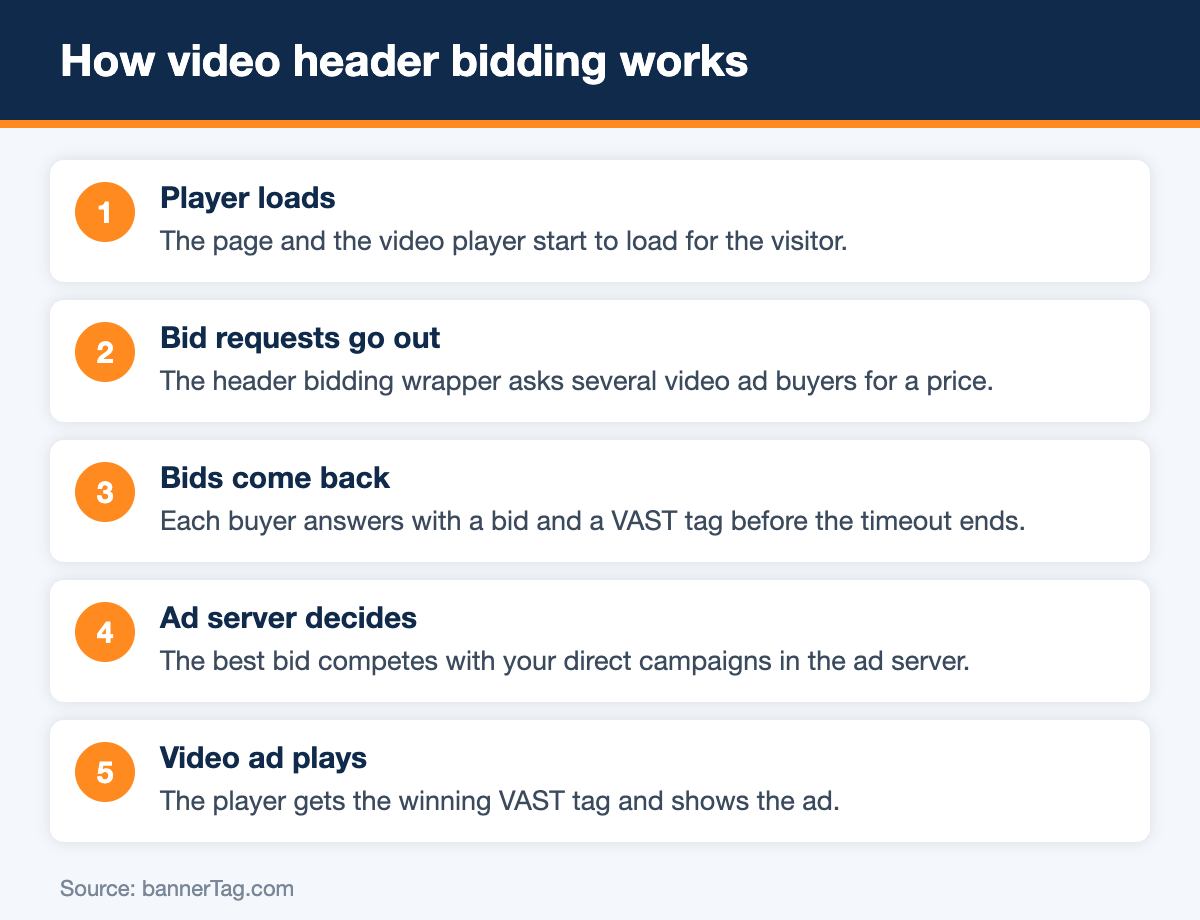
The process takes less than a second. Still, a lot happens in that time.
- First, a visitor opens a page with a video player.
- Next, the wrapper sends bid requests to all connected video partners.
- Then every partner answers with a price and a VAST tag. VAST is the standard that tells a player which video ad to show.
- After that, the highest bid is passed to the ad server, for example Google Ad Manager.
- Finally, the ad server compares the bid with your direct deals and the player shows the winner.
Most publishers build this with Prebid, the open source header bidding project. It supports video bidders, popular players and a cache that stores the winning VAST tag.
Instream and outstream video
There are two main types of video ads. Both can be sold with video header bidding.
Instream video ads
Instream ads play inside a video player next to real video content. For example, a pre-roll plays before a news clip. Advertisers value this format the most. Consequently, it earns the highest prices. However, you need your own video content and a player that supports VAST.
Outstream video ads
Outstream ads do not need video content. Instead, the ad opens between paragraphs of an article and plays when it is on the screen. Because of this, any text website can use them. Prices are lower than instream, but they are usually still higher than display banners.
Benefits of header bidding for video
- More revenue. More buyers compete, so the price for each view goes up.
- Higher fill rate. If one partner has no ad, another one usually does.
- Less waiting. One auction replaces a long chain of calls. Therefore the ad starts faster.
- More control. You set the floor prices and choose which partners can bid.
Challenges to keep in mind
Video is heavier than display. For this reason, a few things need extra care.
- Page speed. Many video bidders in the browser can slow a page down. As a result, most publishers move part of the auction to the server. Read more in our guide to server side header bidding.
- Timeouts. Video bids take longer than banner bids. So give partners enough time, but do not make visitors wait.
- Player support. Your player must work with VAST tags and with your wrapper.
- User experience. Loud autoplay ads annoy people. Above all, follow the Better Ads Standards so browsers do not filter your ads.
How to start with video header bidding
You do not have to build everything alone. Nevertheless, it helps to know the steps.
- Choose a video player that supports VAST and header bidding.
- Pick video demand partners and get approved by each of them.
- Add their lines to your ads.txt file.
- Set up the wrapper with video ad units and a sensible timeout.
- Create video line items in your ad server so the bids can compete.
- Finally, test the setup, check the reports and adjust floor prices.
Small and medium websites often skip these steps and work with a monetization partner. In that case the partner provides the player, the demand and the setup.
Conclusion
Video header bidding brings the proven auction model from banners to the best paid ad format. It adds competition, raises fill rate and removes slow waterfalls. If you already run header bidding for display, video is the natural next step. Start with one player and a few partners. Then measure the results and grow from there.