
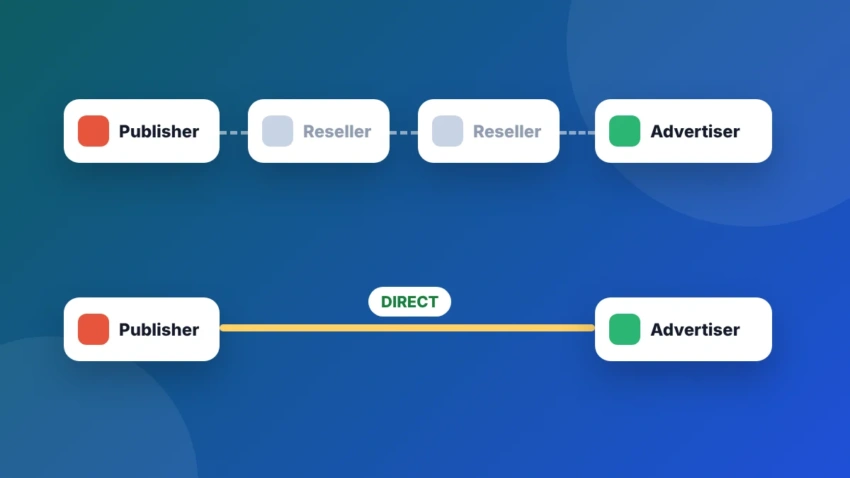
For years most publishers sold their ad space through someone else: an ad network, a monetization partner or a managed header bidding wrapper. That is changing. Advertisers now prefer the shortest path to your inventory, and they pay more for it. This guide explains the move from reseller to direct: what it means, who it suits, what the stack looks like and how to switch without losing revenue.
Reseller vs direct: what the terms mean
| Direct | Reseller | |
|---|---|---|
| Who has the SSP account | You, the publisher | A partner or network |
| Who pays you | The SSP or exchange | The partner, after its share |
| ads.txt label | DIRECT | RESELLER |
| sellers.json label | PUBLISHER | INTERMEDIARY |
| Fees in the chain | SSP fee only | SSP fee plus reseller margin |
| Control and data | Full | Limited to what the partner shares |
You can check how your inventory is sold today with the ads.txt checker. Read ads.txt and sellers.json explained if the labels are new to you.
Why the industry is moving to direct
1. Buyers cut long supply paths
Demand-side platforms use supply path optimization (SPO) to drop duplicate and resold routes to the same impression. In Jounce Media’s April 2026 benchmarks, the most direct paths scored 1.2 on demand against the industry average of 1.0, while rebroadcast reseller paths scored only 0.6. In plain words: the same ad slot attracts about twice as much demand when it is sold directly.
2. Buyers are building direct pipes
The Trade Desk’s OpenPath connects advertisers straight to publishers for a flat fee of about 4.5%, as PPC Land reported. In January 2026 it added OpenAds, a transparent auction backed by publishers like the Guardian, Hearst and Ziff Davis, according to the announcement. These routes only work for publishers with their own direct setup.
3. Google’s auction is opening up
After the antitrust ruling, Google must let AdX bid inside Prebid and rival ad servers, and it has to remove unified pricing rules, so you can set different floors per exchange. That makes an independent stack far more practical. See the Google ad tech antitrust case explained.
4. Managed wrappers are fading
In July 2026 PubMatic shelved its OpenWrap web wrapper, used by about 250 web publishers. As AdExchanger explains, outsourcing header bidding is no longer a big differentiator. Publishers increasingly run Prebid themselves or use self-serve tools that keep them in control.
Who should go direct?
| Your situation | Best fit |
|---|---|
| Under ~1 million monthly pageviews | AdSense or a managed network. Read Mediavine vs Raptive vs Ezoic |
| 1 to 5 million pageviews | Hybrid: own GAM, a few direct SSPs, AdX through an MCM partner |
| 5 million+ pageviews, some in-house tech | Mostly direct: own GAM, direct SSPs, self-managed Prebid, AdX direct if invited |
| Large media group | Fully direct, plus OpenPath-style buyer pipes and your own deals desk |
These bands are rough guides, not rules. Traffic quality, audience countries and your team matter as much as volume.
The direct stack, piece by piece
Your own Google Ad Manager account
The ad server decides which ad wins each slot. The free version of Google Ad Manager covers up to 90 million non-video impressions a month for publishers in the US, Canada, Australia and New Zealand, and 150 to 200 million in most other countries, according to MonetizeMore. Above that you need Ad Manager 360, which is priced by volume. Our Google Ad Manager guide covers the setup.
Access to Google AdX
A direct AdX account is invitation-only. Publisher Collective lists typical minimums of 5 million monthly pageviews and 10 million monthly ad impressions for six months, plus a clean policy record. Smaller publishers get AdX through a Google partner using Multiple Customer Management (MCM). With the Manage Inventory option you keep your own Ad Manager and can work with several partners, which suits a hybrid setup.
Direct SSP contracts
Apply to the SSPs that matter most for your audience and formats. Each one checks your site, signs a contract, adds you to its sellers.json as PUBLISHER and gives you a DIRECT ads.txt line. Most publishers start with three to six. Payment terms are often 60 to 90 days, so plan your cash flow.
Prebid.js and Prebid Server
Prebid runs the auction between your SSPs before the ad server call. Run demanding bidders server-side to keep pages fast, and keep the timeout under control with the header bidding timeout calculator. New to Prebid? Start with the Prebid.js setup guide.
Consent, identity and analytics
You will also own your consent management, user ID modules and reporting. Without a reseller, nobody else will catch a broken consent string or a discrepancy for you. See Google consent requirements.
Managed wrapper vs self-managed Prebid
| Managed wrapper | Self-managed or self-serve Prebid | |
|---|---|---|
| Setup effort | Low | Medium to high |
| Control over bidders and floors | Limited | Full |
| Fees | Revenue share or platform fee | Hosting, tools or a flat fee |
| Data access | Partner’s reports | Your own raw data |
| Vendor risk | The vendor can shut the product | You own the setup |
What a reseller did for you, and who does it now
| Task | With a reseller | When direct |
|---|---|---|
| Ad operations and trafficking | Partner team | Your team or a consultant |
| Collecting payment from many SSPs | One payment from the partner | Many invoices, 60 to 90 day terms |
| Discrepancies and invalid traffic | Partner handles | You monitor and dispute |
| Demand deals and PMPs | Partner’s relationships | Your own sales or curation |
| Brand safety and ad quality | Partner tools | Your blocking rules and tools |
How to switch step by step
- Audit. List every line in your ads.txt, and check which paths are DIRECT and which are RESELLER.
- Open your own Google Ad Manager and rebuild your ad units there.
- Sign two or three direct SSPs that already earn well for you through resellers.
- Set up Prebid with those SSPs, plus your existing partner as a bidder, so nothing is lost.
- Test on part of your traffic. Compare page RPM, fill rate and viewability for a few weeks.
- Watch bidder health. Remove bidders with very low bid or win rates, and keep timeouts low.
- Move more traffic as the numbers improve, and clean old RESELLER lines out of ads.txt.
- Add direct buyer pipes such as OpenPath when your setup is stable.
Measure success by revenue per page view, not CPM alone. Our RPM vs CPM vs eCPM guide explains why, and the ad revenue calculator helps you estimate the gain.
Risks to plan for
- Cash flow: direct SSPs pay later than many resellers.
- Know-how: mistakes in floors, timeouts or consent cost money quickly.
- Lost demand: some resellers bring deals you can’t easily replace.
- More vendors: each SSP is another contract, report and invoice to manage.
Frequently asked questions
What is the difference between a DIRECT and a RESELLER ad path?
A direct path means the publisher has its own account with the SSP or exchange and gets paid by it. A reseller path means another company sells the inventory through its own account and pays the publisher a share. You can see which is which in a site’s ads.txt file (DIRECT or RESELLER) and in the SSP’s sellers.json file (PUBLISHER or INTERMEDIARY).
How big does a publisher need to be to go direct?
There is no fixed number, but each piece has its own bar. A direct Google AdX account is by invitation and is often linked to at least 5 million monthly pageviews and 10 million monthly ad impressions. Many SSPs also want meaningful volume. Below that, a hybrid setup is usually more practical.
Do I need Google Ad Manager 360?
Not at first. The free version of Google Ad Manager allows up to 90 million non-video impressions a month for publishers in the US, Canada, Australia and New Zealand, and 150 to 200 million in most other countries. Above that, or if you need advanced video and audience features, you need Ad Manager 360, which is priced by volume.
Is a header bidding wrapper still needed?
A wrapper is just a managed version of Prebid. Many larger publishers now run Prebid.js and Prebid Server themselves, or use a self-serve tool that gives them control without writing code. PubMatic shelving its OpenWrap web wrapper in 2026 shows that the managed wrapper business is shrinking.
What do I lose when I leave a reseller?
Their ad operations team, their demand partnerships and deals, help with payments and discrepancies, and sometimes access to AdX through MCM. Plan how you will replace each of these before you switch.
Can I go direct step by step?
Yes, and it is the safest way. Start with your own Google Ad Manager account and two or three direct SSP contracts, compare results on part of your traffic, and move more inventory as the numbers prove it.
Conclusion
The move from reseller to direct is about getting closer to the buyer. With fewer middlemen, advertisers see your inventory more clearly and bid more, and you keep a larger share. Google opening AdX to Prebid makes it more practical than ever. Go direct where your scale allows, keep a partner where it still adds value, and move in measured steps.