

Native advertising is everywhere, and its terms are often mixed up. Many people use “native ads” and “in-feed ads” as if they were the same thing. However, they are not. In short, in-feed ads are one type of native ad. Below we explain the difference and show real examples of both.
What are native ads?
Native ads are paid ads that match the look and feel of the page around them. For example, they use the same fonts, image style and layout as the content. Therefore they feel like a part of the website and not like a banner. A small label such as “Sponsored” or “Ad” tells visitors that the content is paid.
Native is a wide group. It includes several formats, and you can see many of them in our native ad examples.
What are in-feed ads?
In-feed ads are native ads that sit inside a feed. A feed is any list that a visitor scrolls through. For instance, it can be a list of social posts, news headlines or products. The ad takes one place in that list and looks like the items next to it.
The IAB describes in-feed as one of the core native ad types. In other words, the format is defined by its position.
In-feed ads vs native ads: the difference
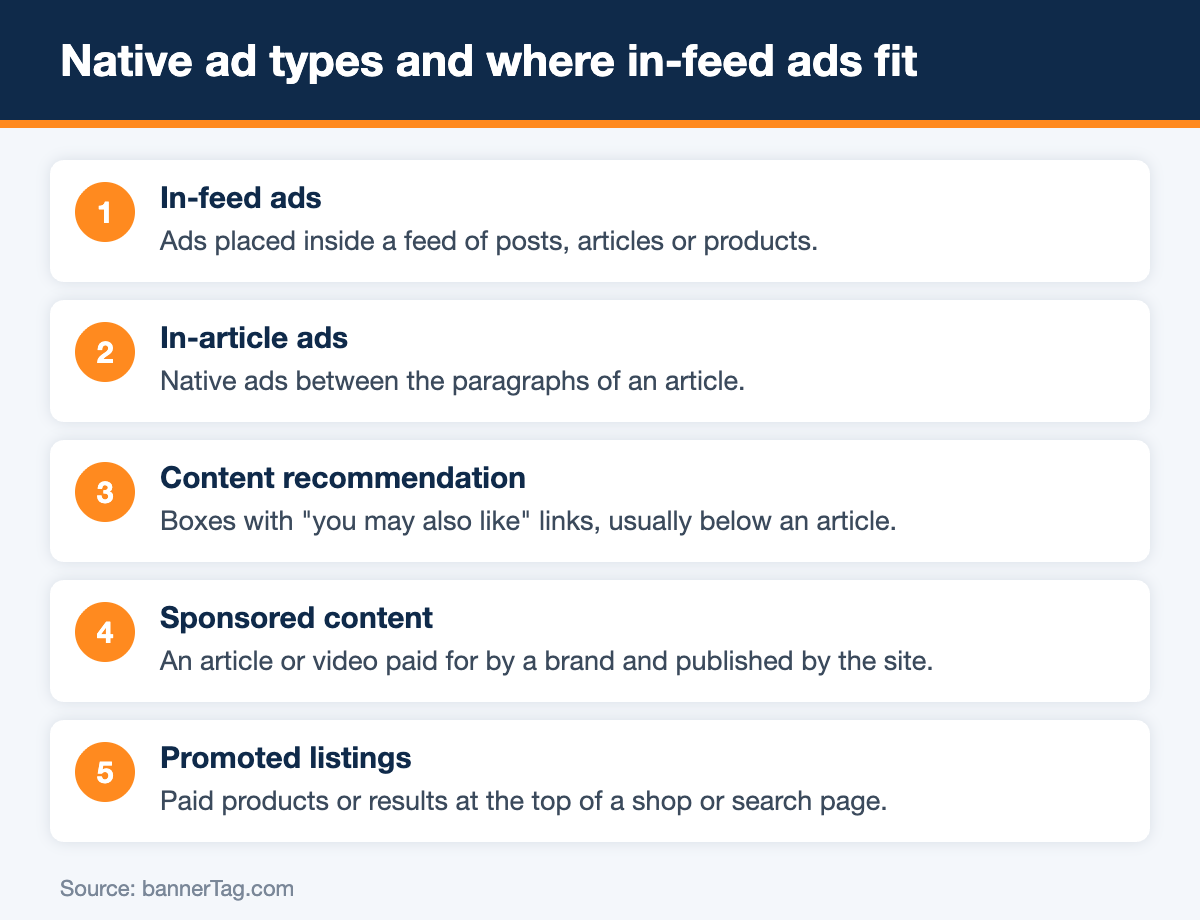
The difference is simple. Native describes how an ad looks. In-feed describes where an ad is placed. So every in-feed ad is native, but not every native ad is in-feed. For example, a sponsored article is native, yet it is a full page and not an item in a list.
Real examples of in-feed ads
Social media feeds
Sponsored posts on Facebook, Instagram, LinkedIn and X are the best known in-feed ads. They appear between posts from friends and pages. Moreover, people can like and share them like normal posts.
News and blog feeds
Many news sites show a paid headline between their own stories on the home page. It has the same image size and the same title style. Only the label shows that it is an ad.
Google AdSense in-feed units
AdSense offers its own in-feed ad unit. You match its style to your list of posts, and Google fills it with ads. As a result, even a small blog can use this format.
Product lists
Online shops place sponsored products inside search results and category pages. These promoted listings look like every other product card.
Examples of native ads that are not in-feed
- Content recommendation widgets. Boxes below an article with links to other websites.
- Sponsored articles. Stories written with or for a brand and published on a news site.
- In-article native ads. Ads between paragraphs that match the text style.
- Branded videos. Videos produced together with an advertiser.
We explain how these formats support a content strategy in native advertising in content marketing.
Why publishers like in-feed ads
- Better experience. The ad does not break the layout, so visitors stay longer.
- More attention. People look at the feed, and therefore they also see the ad.
- Mobile friendly. Feeds are made for scrolling on small screens.
- Extra inventory. In addition, a feed adds ad space without new banners.
Tips for good in-feed ads
- First, match the style of your feed, but always keep the ad label visible.
- Next, do not place too many ads. One ad for every few items is enough.
- Then test different positions in the list.
- Finally, compare the results with your banners. Our guide on CTR and eCPM shows how.
Conclusion
To sum up, native ads are the big family, and in-feed ads are one member of it. Native tells you that the ad fits the design. In-feed tells you that the ad lives inside a list. If your website has a feed of posts or products, this format is an easy first step into native advertising.