
AdSense is where most of us start. You paste one code, Google fills the page with ads, and at the end of the month there is some money in the account. For a small blog that is fine. But sooner or later almost every site owner starts to wonder if there is more money on the table. Usually there is.
We first wrote this list in 2019 and refreshed it in 2020. A lot has changed since then, so here is the 2026 version of our Google AdSense alternatives. Some of them are for sites that AdSense rejected. Others only make sense once you have real traffic. The list is in no particular order, and you can combine several options.
One disclosure before we start: the author of this article works at Setupad, which is number two on the list. Keep that in mind and test everything on your own site.
Why look for Google AdSense alternatives in 2026?
There are three common reasons.
Your site was rejected or limited. Thin content, missing privacy and contact pages, a messy layout or traffic from bad sources are the usual causes. If your account is limited, read how to fix limited ad serving first.
You want more than one buyer. With AdSense, only Google’s advertisers see your ad space. Also, AdSense changed how it pays. Since 2024 you earn per impression and not per click. Google now reports its fee in two parts, and you keep 80% of what is left after the advertiser platform takes its cut. For most sites the final share ended up close to the old 68%.
Traffic is harder to get. Many publishers tell us that search visits are less predictable than a few years ago. So every visit has to earn more. That is why competition for each impression matters. We compared the two approaches in AdSense vs header bidding.
1. Google Ad Exchange (AdX)
Ad Exchange is Google’s premium marketplace, and it lives inside Google Ad Manager. People used to say that you do not find AdX, it finds you. That is still half true. Google does not publish a traffic number. In practice, large publishers get it with Ad Manager 360. Everyone else gets access through a certified partner, using a setup that Google calls Multiple Customer Management (MCM).
Pros
- More buyers than AdSense, including agencies and big brands.
- Floor prices, blocking rules and detailed reports.
- Works together with header bidding in one auction.
Cons
- Hard to get directly unless your site is large.
- You need to learn Google Ad Manager, or let a partner run it.
2. Setupad header bidding (recommended*)
If Google is your only buyer, header bidding is the obvious next step. Many strong ad exchanges will not sign a contract with a small site. A monetization partner such as Setupad solves that, because it already has those contracts and adds your site to them. Setupad is a Google Certified Publishing Partner and a Prebid member. According to its own website, it works with 31 demand partners and asks for about 100K visitors per month.
Pros
- Many buyers compete for every impression, Google included.
- Banner, video and native formats in one setup.
- Someone else takes care of the code, updates and optimization.
- Setupad says it guarantees at least 30% more revenue than AdSense. As always, your result depends on traffic and countries.
Cons
- Not for brand new sites, because there is a traffic requirement.
- The minimum payout is $100, which is higher than with most networks for beginners.
- Payments come later than with AdSense, since ad exchanges pay slowly.
*See the disclosure at the top of the article.
3. Amazon Associates
Amazon made affiliate marketing popular back in the nineties, and its program is still the easiest one to join. There is no traffic minimum. You link to products, and you earn a commission when a visitor buys. Because of this, it is one of the few Google AdSense alternatives that work for a site AdSense has rejected. You can apply on the Amazon Associates page.
Pros
- A product for every niche, and a shop that people already trust.
- If a visitor adds a product to the cart within 24 hours, you still get paid when they buy it within 90 days.
- Low payout threshold: $10 by direct deposit or gift card.
Cons
- Commissions are low. In the US they run from 0% to 10%, depending on the category.
- The cookie lasts only 24 hours.
- Payment by check needs $100.
4. Your own header bidding setup
You can also build header bidding yourself. The open source project Prebid gives you the wrapper for free. However, the code is the easy part. You have to sign contracts with every exchange, run an ad server, keep adapters up to date and handle user consent for European visitors. If you are new to the topic, start with header bidding explained in simple terms.
Pros
- Full control and full transparency. You see every bid.
- No middleman takes a share.
- You learn what your traffic is really worth.
Cons
- It takes a lot of time, and mistakes cost money.
- Good exchanges often refuse small publishers.
- You wait 60 to 90 days for payments from most partners.
- Too many bidders in the browser slow the page down, so you will probably need server side bidding as well.
5. Taboola native advertising
You know those “you may also like” boxes under news articles? Most of them come from Taboola. It is the largest content recommendation network, and big news sites use it for extra income below the article. Taboola works mainly with larger publishers. The numbers quoted publicly range from 500 thousand to 1 million page views per month, so small blogs are often turned down.
Pros
- Uses space under the content that banners do not fill.
- Easy to add, and it works on any device.
- Runs next to your normal display ads.
Cons
- The ads can look spammy, which may hurt how readers see your site.
- High traffic requirement.
- The revenue share is not public.
Not sure what counts as native? We collected native ad examples in another article.
6. Revcontent native advertising
Revcontent does the same job as Taboola, with recommendation widgets under or next to your articles. It has been around since 2013 and is known for being picky about the sites it accepts. The traffic minimum is usually quoted as 50,000 visits per month, although some sources mention much higher numbers. So ask them before you plan around it.
Pros
- Minimum payout of $50.
- Responsive widgets that you can style to match your design.
- Can run together with AdSense or header bidding.
Cons
- Many applications are rejected.
- Like all recommendation widgets, some ads are clickbait.
7. PopAds popunders
PopAds has been selling popunders since 2010. A popunder opens a new browser window behind the current one when a visitor clicks somewhere on your page. It pays per pop, there is no traffic minimum, and approval is quick. Honestly, we would use it only as a last resort.
Pros
- Accepts almost any site, including ones that AdSense will not take.
- Low payout threshold and fast withdrawals.
- You can set your own minimum price.
Cons
- Visitors hate popups. Expect people to leave sooner.
- Google does not allow AdSense on pages that open pops, so you cannot mix the two.
- Pop-up ads are among the formats listed in the Better Ads Standards, and browsers block many pops by default.
8. Carbon Ads
Carbon Ads is a small network for websites about design and development. It belongs to BuySellAds. You show a single, tidy ad per page, usually for a tool that your readers might really use. In fact, it is the opposite of PopAds. The network is selective, and you have to apply.
Pros
- Clean ads that do not ruin a carefully designed site.
- Relevant advertisers for a technical audience.
Cons
- Only for the design and developer niche.
- One ad per page limits how much you can earn.
- Strict rules about placement and about other ads on the page.
9. Sovrn Commerce (formerly VigLink)
Sovrn Commerce turns the normal product links in your articles into affiliate links. You install a script once, and it does the rest. As a result, you do not have to join every affiliate program one by one. The product was called VigLink until Sovrn bought it. It fits forums, review blogs and any site that already links to shops.
Pros
- Thousands of merchants through one account.
- No change to your layout, because there are no banners.
- Works next to AdSense and other ads.
Cons
- You earn only when somebody buys.
- Sovrn keeps part of every commission.
- Recent reviews mention a $50 minimum payout, so check the current terms.
10. Direct sales
Selling ad space yourself is the oldest method, and for a niche site it can also be the best paid. A local company or a brand from your industry often pays far more for a fixed banner than any network would. Large news publishers still sell their best positions this way. Only the leftover space goes to programmatic buyers.
Pros
- You set the price and keep all of it.
- Full control over which ads appear.
- Long contracts bring steady income.
Cons
- Finding clients takes time, and not everyone likes selling.
- You handle contracts, invoices and reports yourself.
- Unsold space still needs a network as backup.
How to choose between these Google AdSense alternatives
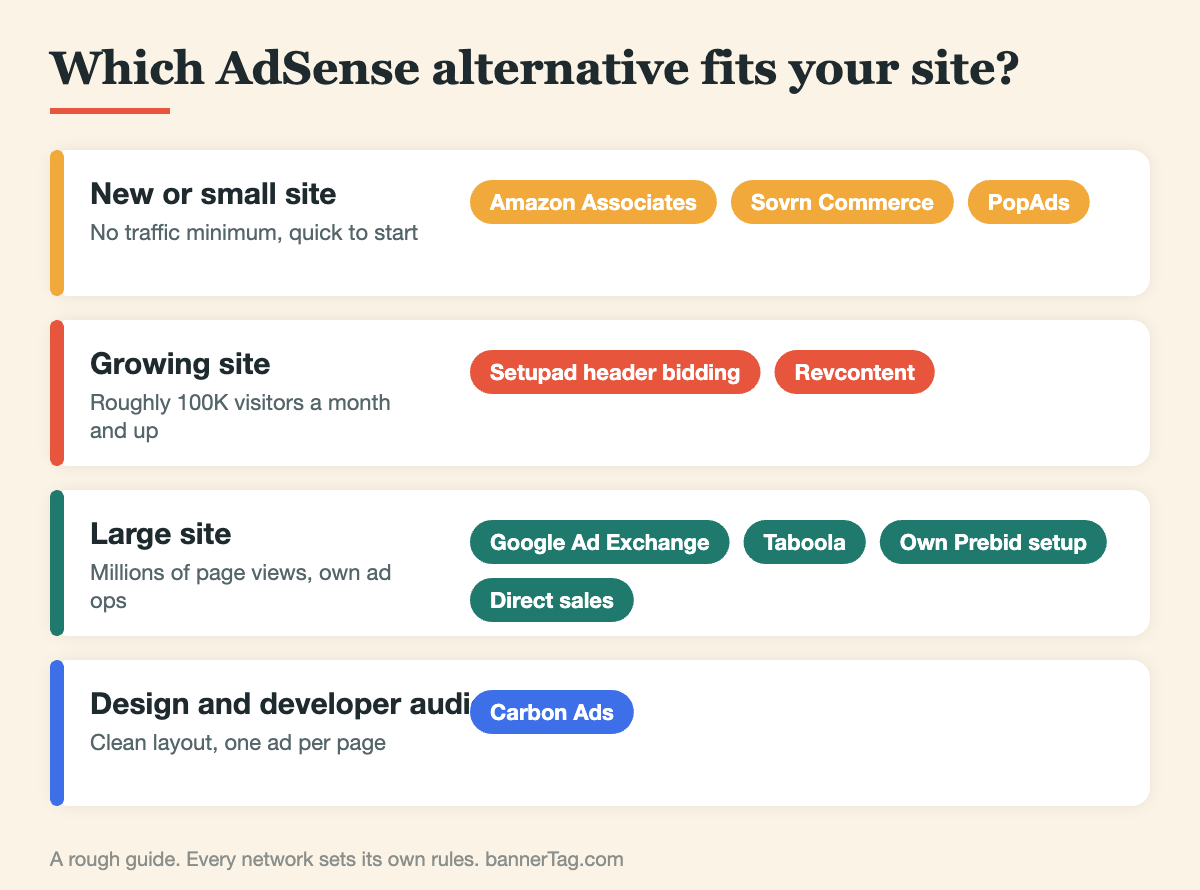
Start with your traffic. A new site should pick something without a minimum, for example Amazon Associates or Sovrn Commerce, and keep growing. Once you reach around 100K visitors a month, header bidding through a partner is usually the biggest single jump in revenue. Large sites can add AdX, a native widget and direct deals on top.
Then test. Run one change at a time for a few weeks and compare revenue per thousand visits, not just CPM. Our guide on how to calculate eCPM and rCPM shows the math. Also, do not forget the basics: good ad sizes, sensible placement and an up to date ads.txt file.
Conclusion
There is no single best replacement for AdSense. Most sites that earn well use a mix: header bidding for display ads, affiliate links inside the content and a few direct deals. Requirements and payout rules change often, so check each network’s website before you apply. And if you tried something that is not on this list, tell us in the comments.