
If you show ads on your website, your reports are full of short names: RPM, CPM and eCPM. They look similar, and they all count money per 1,000 of something. However, they measure different things. If you mix them up, you can easily draw the wrong conclusion about your revenue.
In this RPM vs CPM vs eCPM guide we explain each metric in simple words, show the formulas with real examples and tell you which number to watch when you want to earn more.
RPM vs CPM vs eCPM: the short answer
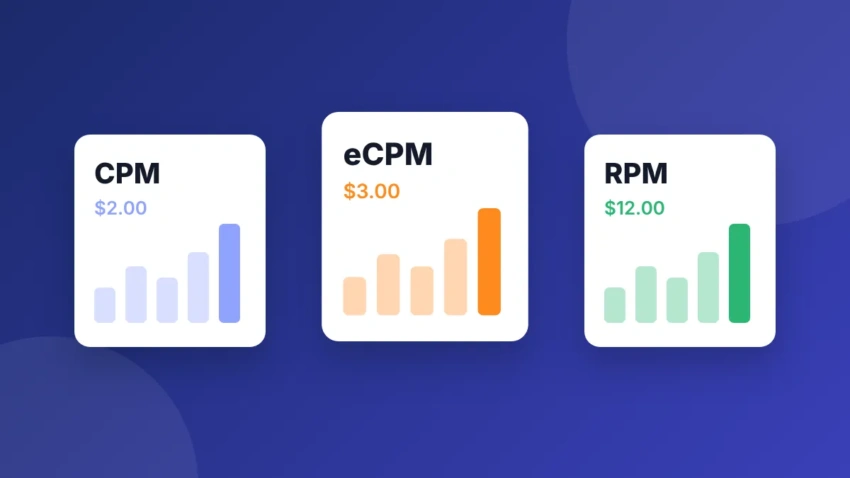
- CPM (cost per mille) is the price an advertiser pays for 1,000 ad impressions.
- eCPM (effective CPM) is what a publisher really earned per 1,000 ad impressions, however the ads were sold.
- RPM (revenue per mille) is what a publisher earned per 1,000 pageviews (page RPM) or per 1,000 ad impressions (impression RPM).
In other words, CPM looks at the buyer’s side, while eCPM and RPM look at the publisher’s side. Page RPM is the widest view, because it includes every ad on the page.
What is CPM?
CPM stands for cost per mille. “Mille” is Latin for thousand. It is the price of 1,000 ad impressions, and it is the most common way to buy display and video ads.
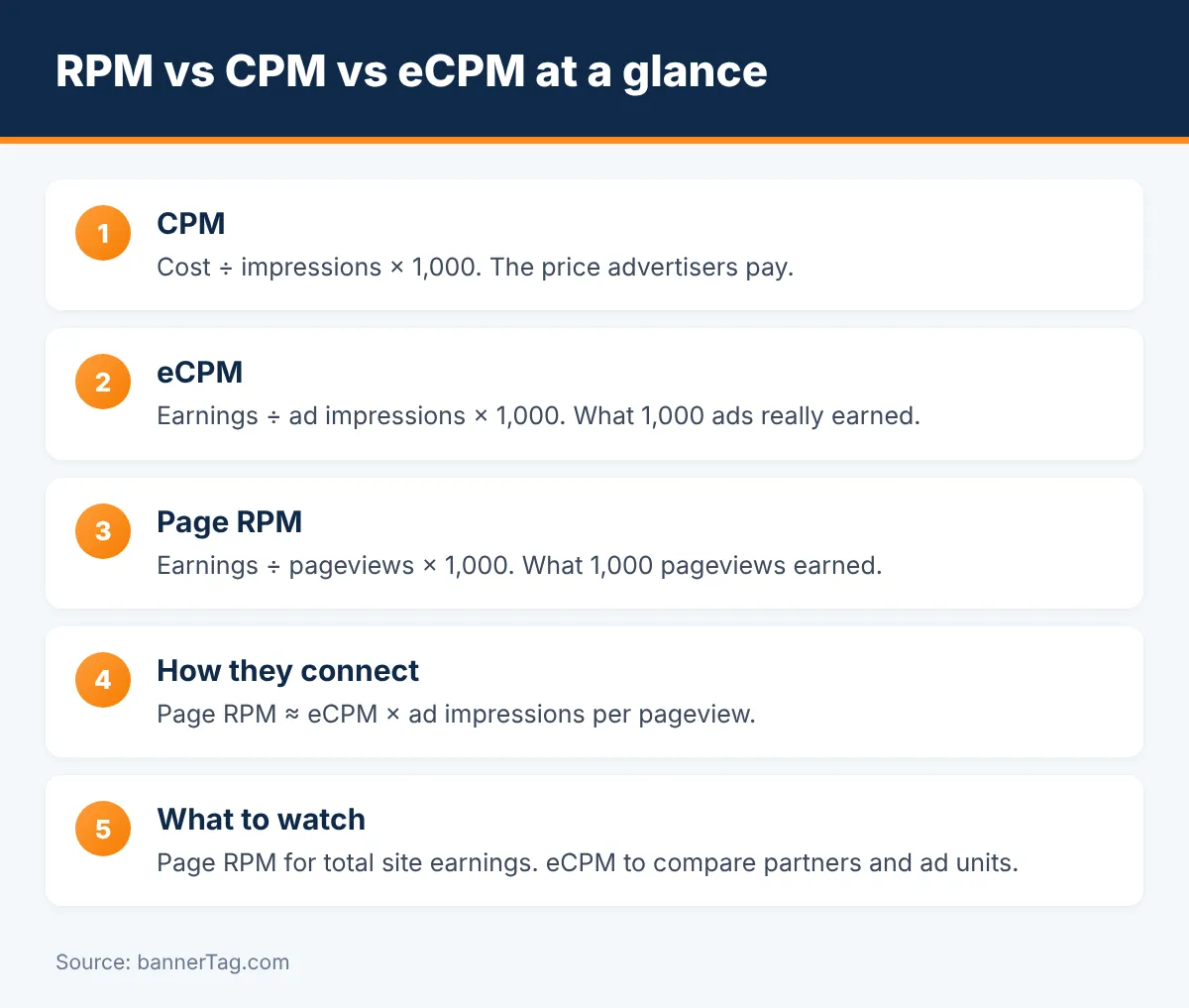
Formula: CPM = total cost ÷ impressions × 1,000
Example: an advertiser spends $500 and gets 250,000 impressions. Then the CPM is $500 ÷ 250,000 × 1,000 = $2.00.
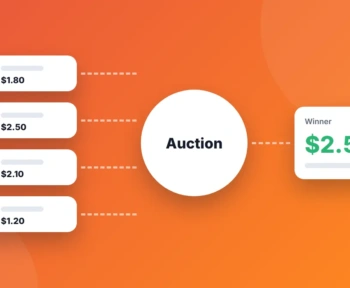
Advertisers use CPM to plan budgets and compare channels. For publishers, CPM is mostly the price that buyers bid in the auction. For example, in header bidding every partner sends a CPM bid, and the highest one wins.
What is eCPM?
eCPM means effective cost per mille. It shows what 1,000 ad impressions actually earned you. The word “effective” matters: not every ad is sold per impression. Some are paid per click (CPC) or per action (CPA). eCPM turns all of them into one number, so you can compare them.
Formula: eCPM = earnings ÷ ad impressions × 1,000
Example: your ads showed 400,000 times and earned $1,200. Your eCPM is $1,200 ÷ 400,000 × 1,000 = $3.00.
eCPM is the best number for comparing ad networks, ad units and sizes. For example, if your 300×600 sidebar unit has a $4 eCPM and your 728×90 header has $1.50, you know which slot is more valuable. Many platforms, including Google AdSense, call this metric impression RPM.
What is RPM?
RPM stands for revenue per mille. It is a publisher metric, and you will see two versions of it.
Page RPM
Formula: page RPM = earnings ÷ pageviews × 1,000
Page RPM tells you how much 1,000 pageviews earn, no matter how many ads each page shows. Google AdSense uses exactly this formula in its reports. It is the best number to compare pages, traffic sources and months.
Example: your site had 100,000 pageviews and earned $1,200. Your page RPM is $1,200 ÷ 100,000 × 1,000 = $12.00.
Impression RPM
Impression RPM divides earnings by ad impressions instead of pageviews. As a result, it is the same idea as eCPM. In the example above, 400,000 impressions earned $1,200, so the impression RPM is $3.00.
Side-by-side comparison
| CPM | eCPM | Page RPM | |
|---|---|---|---|
| Full name | Cost per mille | Effective cost per mille | Revenue per mille |
| Divides by | Ad impressions | Ad impressions | Pageviews |
| Based on | Price paid | Revenue earned | Revenue earned |
| Used by | Advertisers | Publishers and networks | Publishers |
| Best for | Planning budgets | Comparing partners and ad units | Measuring total site earnings |
How CPM, eCPM and RPM connect
The three numbers are linked by two things: how many ads each page shows and how many of those ad requests are filled. Here is a simple way to see it:
Page RPM ≈ eCPM × ad impressions per pageview
Let’s use the same site again. It had 100,000 pageviews and 400,000 ad impressions, so it showed 4 ads per pageview. With a $3 eCPM, the page RPM is $3 × 4 = $12. The numbers match.
This is why a site with a lower eCPM can still have a higher page RPM. For example:
| Site A | Site B | |
|---|---|---|
| Ads per page | 2 | 5 |
| eCPM | $4.00 | $2.50 |
| Page RPM | $8.00 | $12.50 |
Site B earns more per page even though each single ad earns less. However, Site B must make sure the extra ads do not slow the page down or push readers away.
Want to try your own numbers? Use our free CPM calculator. It works out CPM, page RPM or eCPM from any two values.
Which metric should you watch?
Each metric answers a different question. Therefore the right one depends on the decision you want to make.
- Is my site earning more than last month? Watch page RPM, together with total pageviews.
- Which ad network or partner pays more? Compare eCPM on the same ad slots and countries.
- Which ad unit or size is worth keeping? Compare eCPM and viewability per unit.
- How much will a campaign cost? As an advertiser, use CPM.
Be careful with averages, though. A high eCPM on a slot that is filled only 30% of the time can earn less than a lower eCPM with 95% fill. In addition, rates from the US and UK are usually much higher than global averages, so always compare the same countries.
What affects your RPM and eCPM?
- Audience country. Advertisers pay the most for visitors from the US, UK, Canada, Australia and Western Europe.
- Niche. Finance, insurance, software and B2B topics attract expensive advertisers. Entertainment and gaming pay less.
- Season. Rates climb through the fourth quarter and drop sharply in January.
- Viewability. Buyers pay more for ads that are actually seen. Ads far below the fold earn less.
- Ad sizes. Popular sizes like 300×250, 336×280, 728×90 and 300×600 have the most demand. See our banner ad sizes guide.
- Demand competition. More bidders mean higher prices. That is the main idea behind header bidding vs AdSense.
- Page speed and layout. Slow pages and layout shifts lose visitors and lower viewability.
- Ad blockers. Blocked ads count as pageviews but earn nothing, so they pull page RPM down.
How to increase your RPM
Now that you know what moves the numbers, here are the steps with the biggest effect:
- Add more demand. Connect more buyers through header bidding or a monetization partner. Our list of Google AdSense alternatives is a good place to start.
- Improve ad placement. Put ads where people read: inside the content and in a sticky sidebar. Read how to put ads on a website for layout ideas.
- Use multi-size slots. Let several popular sizes compete in the same place.
- Reserve ad space. Set a fixed height for each slot to avoid layout shifts.
- Keep ads.txt correct. Buyers skip sellers they cannot verify. Build a clean file with our ads.txt generator.
- Grow pageviews per visit. Better internal links raise total revenue without new traffic.
Finally, estimate what your traffic could earn with the ad revenue calculator.
Frequently asked questions
Is RPM higher than CPM?
Page RPM is often higher than the CPM of a single ad, because one pageview can show several ads. For example, three ads at a $2 CPM give about a $6 page RPM when every ad is filled.
Is a higher RPM always better?
Usually yes, but check user experience too. You can raise RPM in the short term by adding many ads. However, if visitors leave faster and pageviews drop, your total revenue can fall.
What is a good RPM for AdSense?
There is no single number. Many sites with mostly US or UK visitors see a page RPM between $5 and $20. Sites in finance or B2B can earn more, while gaming or entertainment sites with global traffic often earn less.
What is the difference between eCPM and RPM?
Many ad platforms use the two terms for the same thing: earnings per 1,000 ad impressions. In AdSense this is called impression RPM. Page RPM is different, because it divides earnings by pageviews instead of ad impressions.
Why did my RPM drop?
Common reasons are the season (January is usually the weakest month), more traffic from lower-paying countries, lower viewability after a design change, new ad blockers, or fewer partners bidding.
Conclusion
CPM is the price of 1,000 impressions, eCPM is what 1,000 impressions really earned, and page RPM is what 1,000 pageviews earned. For publishers, page RPM is the best single number for overall performance, while eCPM helps you compare partners and ad units. Track both, compare the same countries and seasons, and focus on more demand and better placements to raise them.